 by Matt Rej


Bridge Payments is a healthcare payment platform that’s designed to help medical, dental, and specialty practices collect patient payments more efficiently. And if you’re using Rectangle Health, there’s a good chance you’re also using Bridge Payments (and paying for it separately).
But the platform itself is somewhat confusing to both existing and prospective users alike. Partially because of its name, but also because of the way it’s marketed and how it works. So I wrote this guide to clear up confusion based on common questions we get from our clients that are either using the platform or considering it.
Few things worth understanding before we jump in:
- Bridge Payments is a software platform, not a payment processor in the traditional sense.
- The actual processing underneath Bridge Payments comes from Rectangle Health, which operates as an ISO (not a standalone processor).
- Most practices using Bridge Payments are paying for it on top of their payment processing costs, typically as a separate monthly fee per location.
- Bridge Payments is not the same thing as BridgePay (though both are used in Rectangle Health).
- While Bridge Payments is most closely associated with Rectangle, it does integrate with other practice management systems too.
What Bridge Payments Actually Is
Bridge Payments is a patient payments collection platform that sits inside Rectangle Health’s larger practice management bridge solution.
From a day-to-day practice standpoint, Bridge Payments is the layer that your staff and patients interact with on the front end. It handles things like text-to-pay links, card-on-file storage, payment plans, in-person tap and swipes, online payments, automated AR posting, and reconciliation.
So instead of accepting payments through a standalone terminal and manually entering it into your practice management system, Bridge Payments is what connects the payment directly to the patient’s account.
But Bridge Payments is not just software or a module. It has payment processing built into the product, facilitated by Rectangle, though it’s not something that users directly see while they’re using it.
How Bridge Payments Works Behind the Scenes
This is the part that matters most if you’re trying to understand how the money moves. And the easiest way to understand Bridge Payments is to separate the software from the underlying merchant services.
Here’s the basic structure:
- Bridge Payments is the front-end software your staff and patients interact with to collect, post, and manage payments.
- A backend Acquirer is the one that actually processes and settles the transactions.
- Rectangle Health sits in the middle as the ISO, providing the merchant services.
- Transactions are routed through a Gateway, which connects the processor to the software.
- Your PMS or EHR receives the payment data and automatically posts the payment to the patient’s records.
From the user’s perspective, everything happens behind the scenes. Your staff accepts the payment via Bridge Payments, and the transaction automatically flows as described.
Rectangle is the one providing both the merchant-facing payment platform (Bridge Payments) and the underlying processing setup. But they don’t operate as a direct processor with their own end-to-end processing infrastructure.
As an ISO, Rectangle relies on outside banks, acquirers, and gateways to complete different parts of the transaction. The exact companies underneath Rectangle can vary depending on the account and configuration. We’ve seen Rectangle accounts connected to Elavon, Vantiv, and Worldpay.
Bridge Payments vs. BridgePay
This is worth addressing directly because the terminology causes real confusion. Bridge Payments and BridgePay are not the same thing.
- Bridge Payments is Rectangle Health’s patient payments software product.
- BridgePay (formally BridgePay Network Solutions) is a third-party payment gateway that Rectangle Health uses to route transactions behind the scenes.
BridgePay is used by Rectangle, but it’s not owned or operated by them. It’s part of the infrastructure that Rectangle uses within its software and payment processing setup, and the name just happens to sound very similar to one of Rectangle’s own solutions.
Most of the time these types of layers aren’t in the public eye, as their roles are all working under the hood.
But it became highly relevant in February 2026 when a ransomware attack hit BridgePay’s gateway infrastructure. And as a result, knocked out Rectangle’s payment processing for over a month. So Bridge Payments (the product) went completely dark because BridgePay (the gateway) was offline.
The short version: if you’re reading about BridgePay anywhere, it refers to a payment gateway from a separate company altogether.
Does Bridge Payments Integrate With Other Practice Management Systems?
Yes, despite being under the Rectangle umbrella, Bridge Payments is designed to integrate with a wide range of different EHR and practice management systems. You don’t need to use a practice management system owned by Rectangle to use Bridge Payments.
For example, a dental practice using Eaglesoft may be able to add Bridge Payments without replacing Eaglesoft. The same general concept applies to medical, orthodontic, optometry, physical therapy, and other healthcare practice systems.
Though there’s an important distinction: Bridge Payments may be practice management system agnostic, but that doesn’t necessarily make it processor agnostic.
What that means is that the platform can connect Rectangle Health’s payment services to a variety of outside platforms. But that’s not the same thing as allowing you to bring any payment processor you want into Bridge Payments.
It doesn’t truly support any bring-your-own-processor model. If you’re using the platform for patient payment collection, then you’re likely forced into using Rectangle Health as your processor.
Bridge Payments Pricing and Processing Fees
Standard pricing for Bridge Payments isn’t publicly published anywhere. And the exact cost will vary based on the size of your healthcare organization, specialty, number of locations, payment volume, software configuration, and services selected.
Simply put, this is all based on a custom quote and it’s all negotiable.
But you need to understand that your Bridge Payments costs should be separated into two different categories:
- Software/platform costs
- Payment processing fees
Healthcare providers commonly focus on the monthly software price and overlook the processing costs. But the processing via Rectangle will usually be a much larger expense.
Here’s a quote that was sent to one of our clients so you can see what I mean:
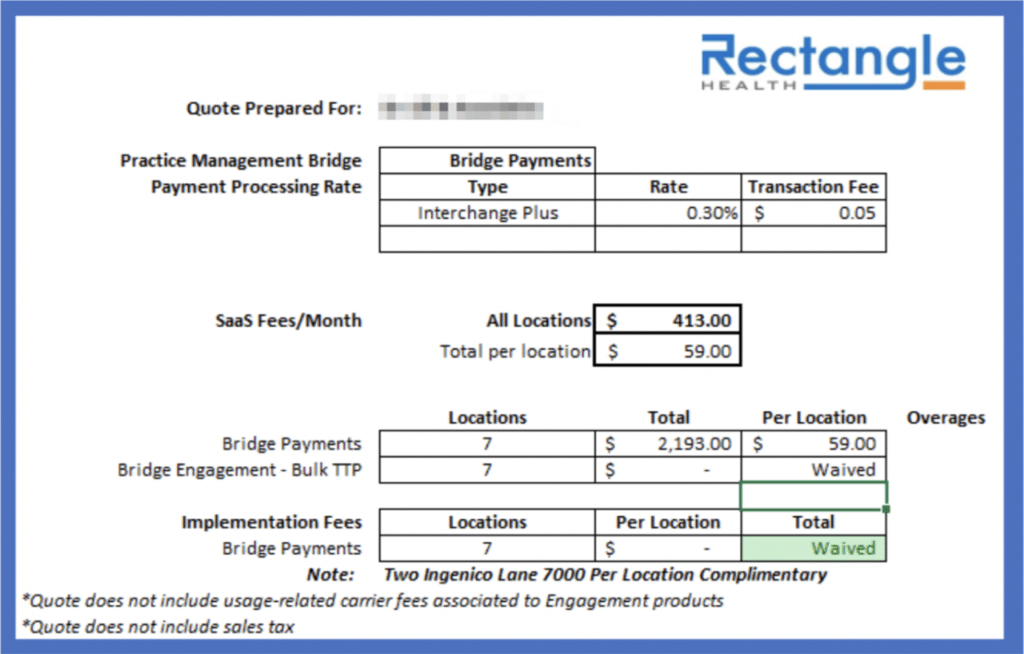
The quote shows Bridge Payments priced at $59 per location per month, bringing the total software cost to $413 per month across all seven locations.
Payment processing markup is quoted separately, at 0.30% + $0.05 per transaction.
You may also notice that the table lists a separate “total” of $2,193 for Bridge Payments. And that figure doesn’t reconcile with any of the other pricing. That’s something we see all of the time when auditing statements and contracts for our clients.
Worth clarifying if you’re sent something like this to ensure you’re not being duped with per-location SaaS fees and Bridge Payments fees being charged separately.
Even at the $413/month rate, this merchant would pay $14,868 in Bridge Payment fees over the three-year term of this contract. And that’s before a single transaction is processed.
So if you’re already set up with another processor, there’s really no reason to consider Bridge Payments anyway. And it’s not like the platform is so good that it justified switching to (and switching processors for). I’d avoid this route.
Final Verdict: Is Bridge Payments Worth It?
Bridge Payments can be a genuinely useful platform for healthcare practices that want patient payments, automated posting, text-to-pay, cards on file, and reconciliation handled from the same interface.
But the software itself isn’t compelling enough to consider switching payment processors just to gain access to these features.
The best fit is for a practice that already uses Rectangle Health and takes advantage of the full platform. Bridge Payments can definitely reduce manual work and make patient collections easier for your team.
That said, pricing is as competitive as it may initially seem.
Rectangle uses Bridge Payments as a way to get you to spend more money on top of your payment processing costs. And the processing fees aren’t necessarily cheap, either, because of both the ISO arrangement and integrated setup.
You’re paying a premium for this service. And that cost is tough to defend, especially coming from a processor that was involved in the largest payments outage in history.
If you’re already using Bridge Payments, I strongly recommend that you find ways to negotiate and save money on your account. But if you’re not already set up here, I recommend looking elsewhere or sticking with your current setup.