 by Matt Rej


If you’re using Worldpay to process card payments and you notice a Transaction Risk Fee (TRF) or Processor Transaction Risk Fee when auditing your statements, you’re right to question whether the fee is legitimate.
I’ll tell you upfront, it’s not.
This is one of those charges that’s designed to look and sound legit, as Worldpay even itemizes it by card network, with slightly varying rates for each one.
But it’s a pure processor markup. The rates are arbitrarily applied, and the fee itself can be completely negotiated off of your statement.
Let me break it all down for you.
What Exactly is Worldpay’s Processor Transaction Risk Fee?
Transaction Risk Fees are percentage-based markups that Worldpay applies on top of your base processing rates. It’s usually broken out by card brand, so a single statement might show four separate TRF lines for Visa, Mastercard, Discover, and American Express.
You’ll see it show up under a few different names depending on your statement format:
- Transaction Risk Fee
- Processor Transaction Risk Fee
- TRF
Standard Worldpay pricing agreements for new merchants show the TRF fee up to 0.85% per applicable transaction. But as you’ll see, the exact amount is arbitrary and varies by network and merchant.
Like similar “risk” fees we see from processors industry-wide, Worldpay uses this extra markup to charge more for transactions that they deem to carry a higher risk. Which is typically any card-not-present (CNP) transaction or card-present transaction that was swiped instead of tapped/dipped, not authorized properly, or not settled in time.
For many merchants, the fee ends up being applied to a large percentage of their total transaction volume.
How Much Does it Cost?
Transaction Risk Fees can be charged up to 0.85% per transaction, with varying amounts for each card network below that ceiling.
The rates we’ve pulled from Worldpay statements have run anywhere from 0.45% to 0.83%, with most blended effective rates on this fee falling around 65 bps.
While Worldpay doesn’t put the rate itself for this fee on the statement, you can calculate it by dividing the fee charged by the applicable processing volume for each card brand.
What Makes This Fee So Tricky
Some junk fees are easier to spot because they have vague names, round numbers, or a single line item with an amount so high that it jumps off the page at you. But Worldpay built this one carefully, which is why it often slips through the cracks when merchants are reviewing their statements each month.
Here are all of the elements working together to make the TRF seem legitimate to the untrained eye:
Itemized by Card Brand: Network fees genuinely do get billed this way, so seeing separate lines for Visa, Mastercard, Amex, and Discover match what real pass-through fees look like on a statement. And it’s easy to let your guard down when you see those names spelled out.
Not Applied on Full Volume: Not every transaction is subject to the fee. Though upwards of 80% to 90% of your volume may get hit with this charge, the fact that the volume numbers don’t exactly match the full amount for each network seems less suspicious than all of your transactions getting hit with risk fees.
Rate is Different for Each Brand: This is the detail that is the most challenging for merchants to overcome when conducting their own internal statement audits. Different rates per network implies that the fee is tracking something real at the network level. Because why else would Visa and Mastercard cost different amounts?
In all honesty, this is by far one of the most challenging hidden markups for merchants to uncover for these reasons, especially the last one. If you go through all the obvious signs of a junk fee, this one doesn’t really meet most of the criteria.
Examples of Merchants Paying Different Rates for the Same Fee
Here are a few Transaction Risk Fee rates I pulled from three Worldpay statements.
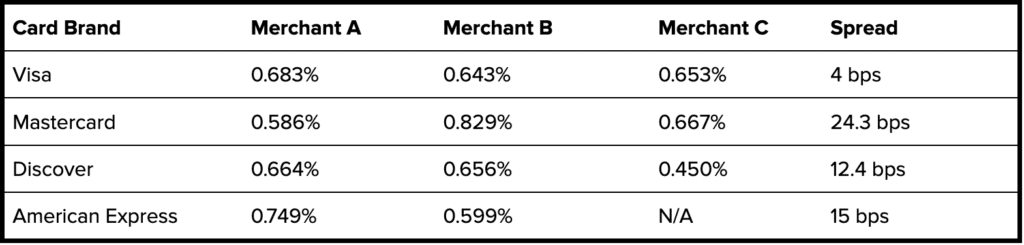
Three merchants using the same processor. While the same Mastercard “risk” costs 24 basis points more for Merchant B than it does for Merchant A.
There’s no version of a legitimate network fee where that happens.
If you look at the order, Mastercard is the cheapest for Merchant A and Amex is the most expensive. But that’s reversed on Merchant B’s statement (MC most expensive, Amex cheapest).
Now let’s look at the statements so you can see how these rates translate to dollars:
Merchant A – $172,526 total volume
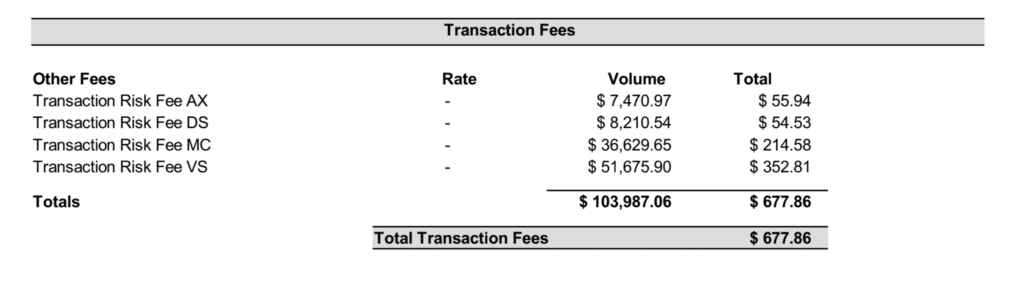
- $103,987 subject to TRF
- 60.3% of volume hit with TRF
- $677.86 Transaction Risk Fees
- ~$8,100 per year
Merchant B – $166,445 total volume

- $122,510 subject to TRF
- 73.6% of volume hit with TRF
- $837.29 Transaction Risk Fees
- ~$10,000 per year
Merchant C – $276,451 total volume

- $272,185 subject to TRF
- 98.5% of volume hit with TRF
- $1,786.48 Transaction Risk Fees
- ~$21,400 per year
Proof It’s Optional: The Fee is a Checkbox
To be clear, interchange fees and network assessments are never optional. Those are set by the brands and paid to networks and issuing banks.
Rates are the same across the board, and nobody is exempt.
But that’s not the case with Worldpay’s Processor Transaction Risk Fee. And the proof is in Worldpay’s pricing agreement:

Look at the language here.
Unless the box is checked, IC+ pricing is subject to the fee. But the Transaction Risk Fee is Not applicable when the box is checked.
While the fee can run as high as 0.85%, what’s more interesting is the fact that the number before that is left blank, so a sales rep can fill it in with nothing but a ceiling.
That blank link is why the merchants in the examples above are paying different rates. Nothing is being calculated. Someone just wrote a number down.
Some Merchants Don’t Pay It At All
Here’s a full page of fees from another Worldpay merchant statement:
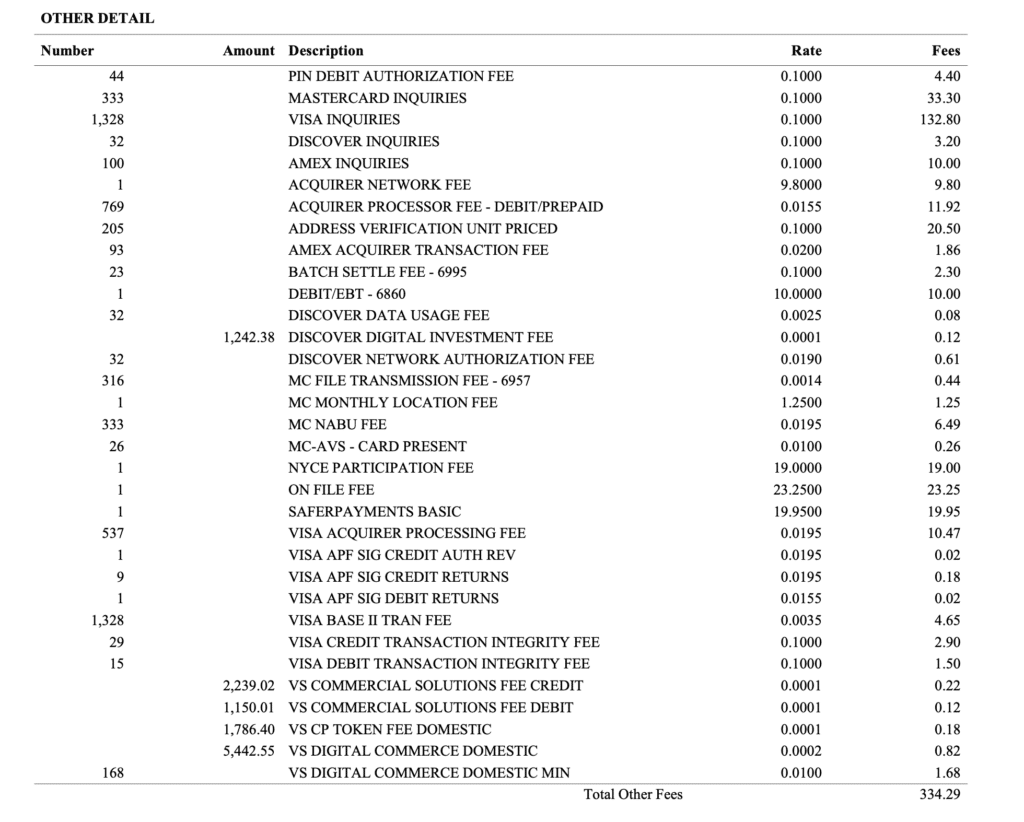
No Transaction Risk Fees are applied anywhere.
If TRF were a genuine cost that Worldpay incurred, they would certainly not decide to eat it for some accounts and bill it to others. They simply charge it whenever possible unless a merchant pushes back, and then they’ll remove it.
We’ve seen this same billing tactic used by other processors, too. Global Payments has their own version that they call a Risk Assessment Fee. What’s funny is that Global now owns Worldpay, but each processor had been doing this independently even prior to the acquisition.
I’ve yet to see a Worldpay statement that includes both a Processor Transaction Risk Fee and a Risk Assessment Fee, but I’m sure the day will come.
Final Thoughts
The Transaction Risk Fee from Worldpay is not a mandatory network assessment, which means it’s a processor markup that’s 100% negotiable. If you’re paying it, you can either get the rate lowered or have it removed from your statement altogether.
Worldpay may tell you that the fee is applied to higher risk transactions like CNP activity. Fine. That may explain why certain transactions get hit. But it doesn’t explain the rate.
The fact that they charge different amounts, not only for different merchant accounts, but for different networks on the same account proves that the rate is arbitrary. What makes a Mastercard transaction more risky than a Discover transaction? Nothing.
Reach out to Worldpay ASAP to get this fee removed from your account. And continue monitoring your statements moving forward to ensure it doesn’t get added back or show up under a different name (like risk assessment).
If you need help negotiating with Worldpay or uncovering other hidden fees on your statement, reach out to our team here at MCC and we’ll handle this on your behalf. You don’t need to switch providers to save money on credit card processing.