 by Matt Rej


Payment processors are always looking for new ways to charge you more money. And it’s even more profitable for them if the charge isn’t actually tied to a specific service.
How do they do it?
One approach is when a processor basically invents a fee out of thin air.
But they obviously can’t just add a charge to your statement itemized as “extra markup” or “junk fee.” So they need to get a bit creative and name the fee something that you’re less likely to question.
I’ve noticed that around the end of the year is a time when processors start using terms like “government” and “regulatory” or even “compliance” as justification for a fee.
This is all junk. I’ll show you some examples and explain why.
A $699 Annual Government Fee With No Regulation Behind It
Here’s a notice that I found attached to a client’s statement last month. This is a dental practice in Massachusetts using Worldpay (which is now owned by Global Payments) for credit card processing.
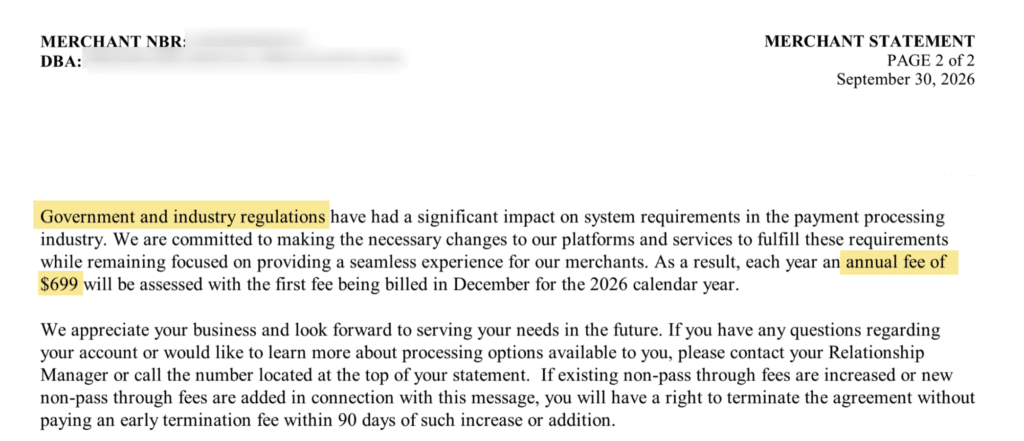
It basically says that a $699 annual fee will be charged on December 2026 statements:
I’ve previously called out how annual fees in payment processing are garbage because they’re pure processor markups. And how they often pop up later in the year, especially in December. So this all checks out here, too.
But what’s different about this one is that Worldpay/Global is blaming “government and industry regulations” for the charge.
And at a quick glance, it sounds very official. Worldpay even claims that they’re “making necessary changes to fulfill these requirements.”
The implication is that there’s some type of government-related cost burdening Worldpay, and they’re recouping the cost from the merchant. But it’s complete nonsense.
What government agency are they referring to? What specific regulation is this for? What exactly is the requirement?
It’s just a flat $699 fee that isn’t tied to anything.
The most damning evidence of this being a junk fee is in the second paragraph of the same notice:
“If existing non-pass through fees are increased or new non-pass through fees are added in connection with this message, you have a right to terminate the agreement without paying an early termination fee.”
That’s the processor admitting that this isn’t a pass-through fee. No government body is collecting this money, which means it’s all revenue for Worldpay/Global.
Global Payments Used the Same Playbook Last Year
This isn’t an isolated incident. And if you look at the history of this phantom fee, it becomes even clearer that nothing is tied to an actual government requirement.
Here’s a similar statement notice that I pulled from last year, this time from a Heartland account (also owned by Global Payments).
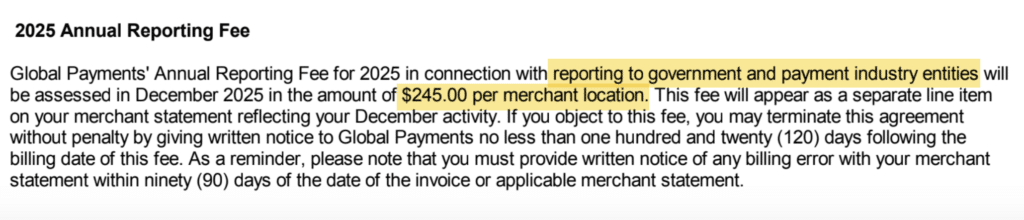
Again, it’s a Global Payments annual fee being charged in December. Except this time the fee is tied to “reporting to government and payment industry entities.”
They still get in those buzzwords to make it all seem legitimate.
Last year merchants were charged $245 per location for this “reporting” fee. And now fast forward to 2026, and it’s $699 to keep up with government requirements.
Real regulatory costs don’t nearly triple in a year.
It’s just a pattern of Global Payments using its subsidiaries to charge annual fees, using deceptive language so merchants don’t question it.
Why These Fees Don’t Hold Up
If these were truly tied to some type of government agency or industry regulation, then we’d see them on every merchant account, every year at the same price.
And we simply don’t.
Some processors do have their own version of this. For example, Shift4 has a Regulatory Assurance Fee, that’s allegedly tied to PCI compliance (it’s not). We’ve also seen Annual Regulatory Fees from North (American Bancard).
But the price, timing, explanation, and inconsistency industry-wide prove that they aren’t actually tied to anything specific. Which means it’s just your processor adding a new fee to your account.
Now, I’m not suggesting that your processor doesn’t have to do some type of compliance and reporting, like 1099-K filings or any PCI-related platform work. They absolutely do.
But that’s the processor’s own cost of doing business, and not a service they’re providing to the merchant. And it certainly doesn’t cost $700 to generate and file a 1099.
What Can You Do About It?
If your payment processor tries to charge you for some type of government-related or regulatory compliance fee, push back against it.
You have leverage.
As you can see from the statement notice examples, these types of fees can typically mean that you can terminate your merchant account (though I’m definitely not suggesting that).
Instead, the fact that your processor knows you can walk away can be used to your advantage. They don’t want to lose out on the tens of thousands of dollars they get from you every year over $600 or $700 one-time fee.
So ask them to waive it. And while you’re at it, look for other junk fees on your account and try to get your standard markup lowered too.
They opened the door to this type of negotiation by billing you for something ridiculous. And can 100% still negotiate your rates even if you’re under contract.
If they won’t budge or if you need a little help, contact our team here at MCC, and we can handle all of this on your behalf. No switching processors, just saving money.