 by Matt Rej


I spend a lot of time writing about how payment processors overcharge businesses. But not every merchant account is bad.
Fair processing rates are out there. And you don’t need to be a national retailer processing $5 million per month to get a good deal.
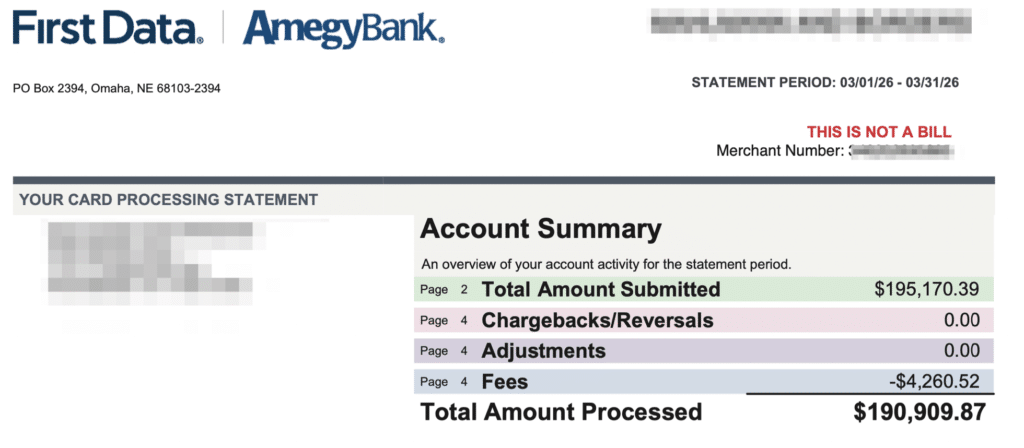
The statement below is from a local orthodontic practice that processed $195,170.39 during the month. They paid $4,260.52 in fees, which is a 2.18% effective rate.
This is a good deal for any business, but especially one of this size.
It’s also worth noting that my team here at MCC had previously negotiated with the processor (First Data) to improve the pricing and remove additional markups prior to this billing period. So this is what a fair post-negotiated rate looks like on a real statement.
A Real Business Paying a 2.18% Effective Rate
The effective rate shows how much a business actually pays to accept cards after every processing charge is included. The calculation is straightforward:
Total Processing Fees ÷ Total Card Volume = Effective rate
For this merchant:
$4,260.52 ÷ $195,170.39 = 2.18%
The practice completed 831 transactions during the month, putting its average transaction at roughly $235. This is a meaningful amount of processing volume, but it’s far from the type of massive enterprise account that merchants assume is required to get competitive pricing.
This is a local small business that pays a little more than $0.02 for every $1 accepted by card.
Where the $4,260 in Processing Fees Went
The $4,260.52 in total fees breaks down into three buckets:
- Interchange Fees — $3,637.92
- Service Charges — $412.08
- Fees — $210.52

As a percentage of the merchant’s monthly processing volume, that works out to approximately:
- 1.86% for interchange and card-brand program fees
- 0.21% for service charges
- 0.11% for other fees
- 2.18% total effective rate
Interchange makes up the bulk of it, and that’s exactly what your statements should look like. These are the non-negotiable charges set by the networks and paid to issuing banks.
When interchange is the majority of your effective rate, it’s a sign that your processor isn’t stacking a ton of margin on top of it.
The service charges went straight to the processor, and the other fees are a mix of both processor fees and network assessments. This is typically where processors love to bury hidden margin. But in this case, that’s not happening excessively.
The Processor Markup is Competitive, Not Unrealistic
This merchant has interchange-plus pricing, with a discount rate of 0.20% + $0.10 per transaction for Visa, Mastercard, and Discover.
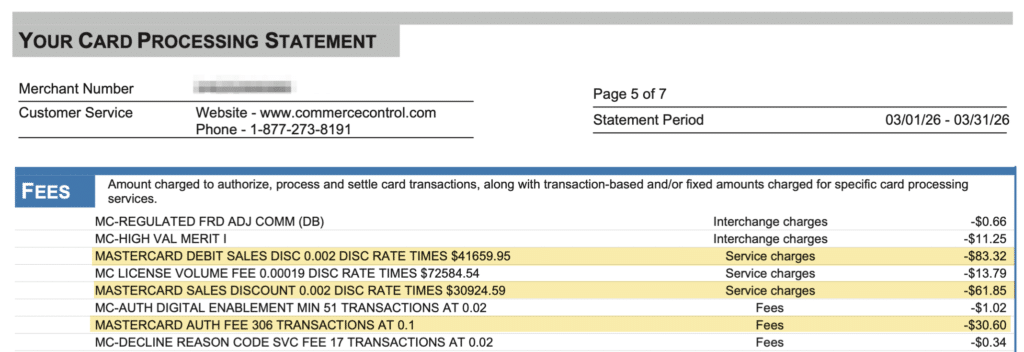
Amex is 0.15% + $0.10 per transaction (proof that accepting American Express isn’t always more expensive).

Overall, 0.20% + $0.10 is a fair rate.
But it’s not some unheard-of floor or an impossibly low arrangement that’s only available to the country’s largest merchants.
To put this into perspective for you, one of the cheapest rates we’ve ever seen is 0.03% + $0.03 per transaction, which was offered to an ecommerce merchant doing $250+ million annually.
A 20 basis-point discount rate and a $0.10 per-authorization is definitely attainable for smaller merchants with a clean processing history, and these statements prove it.
Other Reasons Why This Merchant’s Effective Rate is Close to 2%
The competitive discount rate is only one reason why this merchant is able to get a good deal from their processor. There are several other parts of the account working together in the merchant’s favor.
Interchange-Plus Pricing: The processor’s markup is transparent and clearly separated from the underlying interchange costs. This gives the merchant the benefit of any lower-cost transaction instead of paying something like 2.9% + $0.30 even when the underlying wholesale costs are significantly cheaper.
Limited Extras: In addition to the discount rate and authorization fees, the other processor fees are minimal. First Data is charging a Clover Security Plus Fee for $8.95 per month and a $39.95 PCI Fee. While both add to the processor’s total margin, neither are unreasonable amounts.
Favorable Card Mix: This merchant has quite a bit of debit card sales, which carry a lower interchange rate compared to credit cards. Even though they processed online transactions, business cards, and premium rewards cards (all more expensive), their debit sales definitely helped even things out.
High Average Transaction Amount: The fixed $0.10 per authorization fee has less of an impact on the effective rate when the average sale is $235. Businesses with thousands of small ticket transactions could have a higher effective rate even if the discount rate was identical.
No Chargebacks or Reversals: During this particular month, there were zero chargebacks, refunds, or other reversals. It keeps the calculation clean and avoids any dispute-related costs that would otherwise increase the effective rate.
Professional Negotiation: This statement didn’t arrive with such favorable pricing automatically. Our team here at MCC reviewed this merchant account and then negotiated directly with First Data on behalf of the merchant to negotiate better terms. We eliminated junk fees and helped them get a fair rate without having to switch processors.
You Shouldn’t Accept 3% or 4% as Normal
There are so many businesses out there that aren’t scrutinizing their merchant fees as closely as they should be. I’m not sure why, but for some reason, they just assume that 3% or even 4% is the standard cost to accept credit cards.
It’s not.
Taking the time to review your statements and negotiate with your provider can result in real savings.
Let’s say this merchant was paying 4% effective. At roughly $200k per month in volume, that’s $8k in monthly merchant fees. The difference between 2% and 4% at this volume represents about $48,000 in savings on the year.
Now scale this up. A merchant doing $600k monthly at 4% effective could be leaving over $140k-$150k in savings on the table every single year.
2% may not be attainable for everyone. But even if you meet somewhere in the middle, $50k in savings isn’t that far-fetched.
Is It Possible to Pay 2% on Credit Card Processing?
Absolutely.
This example proves that you can get fair pricing under normal operating conditions for an average business. And you don’t need to be processing millions every month or switch processors to get a fair rate.
Sometimes the difference comes down to having someone review your statement to identify where the extra costs are coming from and negotiate the account properly.
If you haven’t done this, there’s a good chance you’re paying more than you should be. By how much? You can find out by getting a free audit from our team at Merchant Cost Consulting.