 by Matt Rej
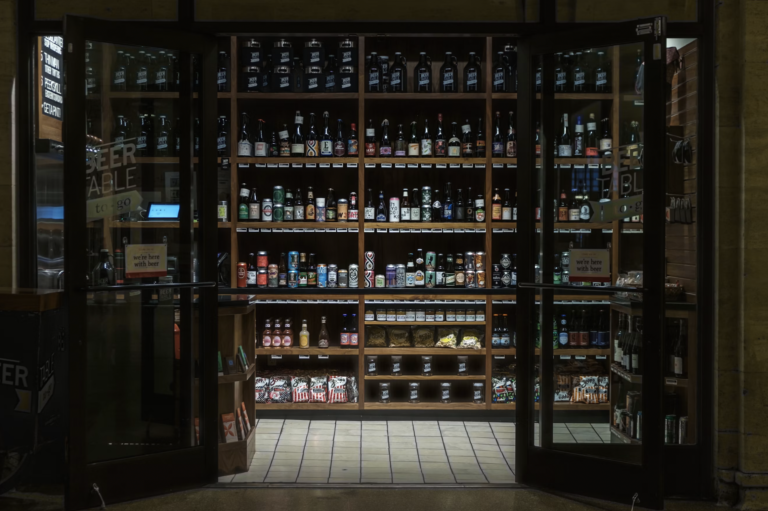

Search for “alcohol payment processing” or “liquor store merchant account” and you’ll find no shortage of processors ready to tell you that alcohol is a high-risk industry that requires specialized high-risk merchant accounts.
But that’s not necessarily true.
While alcohol is regulated and certain ways of selling it can create additional risk for processors, standard in-person card transactions for beer, wine, or liquor shouldn’t come with a high-risk price tag.
For the vast majority of brick-and-mortar alcohol retailers, premium prices on credit card processing simply aren’t warranted.
Does Selling Alcohol Automatically Make You a High Risk Merchant?
No. Alcohol isn’t a high-risk merchant category just based on the product alone.
High-risk merchant account designations are supposed to reflect financial liabilities for the processors and banks involved in moving the money. Factors like a high chargeback ratio, card-not-present transactions, and a history of fraud exposure.
And while some high-risk MCCs are product-based (like TCH, firearms, adult materials, etc.), alcohol sales are not automatically riskier for processors to transact.
Your business model, transaction environment, and processing history should drive the underwriting on your alcohol merchant account. Not simply the presence of alcohol being sold.
Where the High-Risk Label Comes From
There are some legitimate reasons why certain alcohol businesses require more scrutiny from processors. Alcohol sales involve age restrictions and licensing requirements. And alcohol selling online can introduce even more regulatory considerations around where products can be shipped and how the customer’s age is verified.
Online liquor sales are also subject to the same payment risks that apply to virtually any industry (CNP, fraud exposure, shipping delays, etc.). Beer and wine subscriptions also have an increased risk, but because of the recurring billing element.
All of these factors relate to how the alcohol is sold. Not the alcohol itself.
The problem is that processors often take those legitimate risk factors and apply them broadly to the entire alcohol industry. They know people are searching for “alcohol merchant account” so they’ve built marketing around telling you that your industry is high risk and you need a special merchant account.
If your processor says that alcohol is high-risk, it sounds believable enough to accept. That framing can make a perfectly ordinary liquor store assume that higher processing rates, reserves, or restrictive contract terms are simply the cost of doing business.
But the card networks themselves don’t treat alcohol as high risk. The high-risk designation comes from the processor, which means it’s fully negotiable. And in many cases, it shouldn’t be there at all.
What a Real Liquor Store Actually Pays
I have a real merchant statement from one of our clients to help put this into perspective. It’s a brick-and-mortar alcohol retailer using Moneris for payment processing.
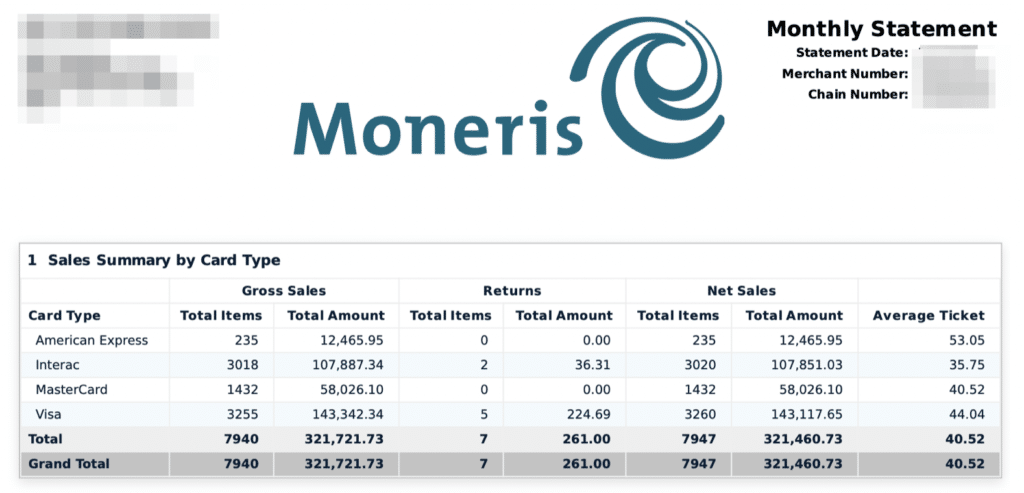
During this month, they processed $321,721 in total volume across 7,947 transactions.
At nearly $4 million annually for a single location, it’s real volume and deserves a fair rate. Especially since they’re an established business with a low chargeback history.
As a result, Moneris charges them just $0.04 per transaction.
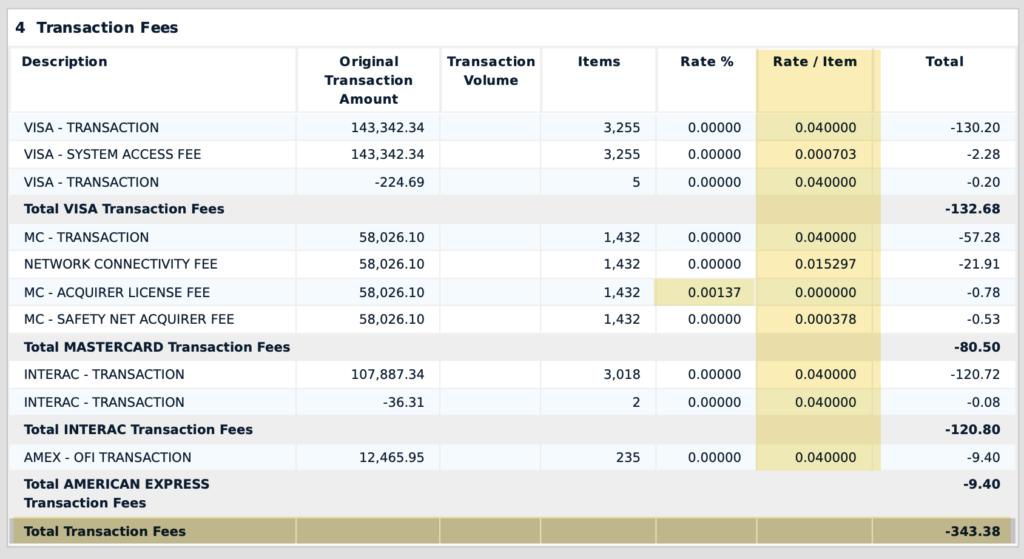
You can see the $0.04 rate applied to all Visa, Mastercard, Interac, and Amex transactions equally.
On top of the transaction-based charges, Moneris also charges a handful of service fees totaling $92 this month, which is practically nothing at this volume.
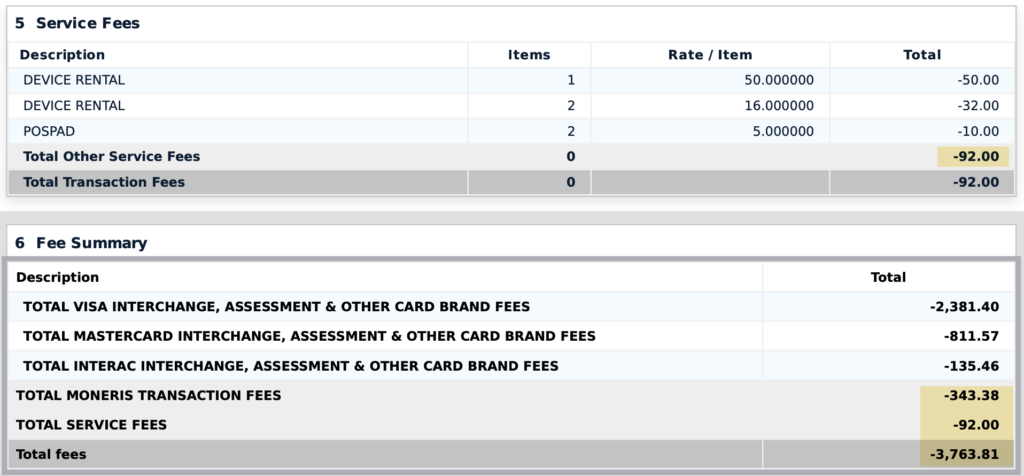
All in, we’re looking at:
- $3,763.81 total processing fees
- $3,048.20 interchange (paid to issuing banks)
- $280.23 assessments (paid to networks)
- $435.38 fees to Moneris (the processor)
- 1.17% total effective rate
- 13.5 bps markup to the processor (0.135%)
It’s an incredible deal, and nowhere in the same ballpark of what would be considered a high-risk rate. Proof that alcohol sales alone don’t warrant higher processing rates.
The statement includes a higher percentage of Interac debit volume, which lowers the overall effective rate. But the debit portion of this favorable card mix only affects the interchange cost. The processor’s markup still holds true at around 13 basis points across the board.
If we eliminate the debit sales and Amex direct agreement, the effective rate on Visa and Mastercard is roughly 1.69%. With a high-risk processor, your effective rate could easily be double or triple this number.
Not All Alcohol Sales Have the Same Risk Profile
Traditional liquor stores will typically be assigned MCC 5921 — Package Stores: Beer, Wine, and Liquor.
Visa defines this category as merchants selling packaged alcoholic beverages for consumption off premises. Mastercard uses the same MCC and explicitly supports both face-to-face and non-face-to-face transactions within the category.
There isn’t a separate high-risk variation of this MCC code. But your own processor or bank may underwrite your account based on its own criteria. That determination should reflect how your business operates, and not simply based on the fact that you sell alcohol.
Here’s how your risk profile can change depending on the business model of your alcohol sales:
Brick-and-mortar liquor stores: If you have primarily card-present transactions with products handed directly to the customer, it’s the most straightforward model from a processing perspective and poses the least amount of risk.
Bars, breweries, and taprooms: Lower risk for mostly card-present transactions. But these businesses typically fall under different MCC codes than package stores or liquor stores.
Wineries with tasting rooms: In-person sales may be straightforward and cheap, but ecommerce shipping or a wine club subscription can change the risk profile.
Online alcohol retailers: CNP transactions introduce additional fraud and chargeback exposure, along with shipping and age-verification considerations. Costs can be higher here, but not necessarily justifiably higher than any other ecommerce company.
Wine and beer clubs: Recurring billing adds another potential source of disputes, particularly around renewals and cancellations which can carry higher risk for the processor.
Alcohol delivery businesses: Delivery, age verification, and proof of receipt can make underwriting more complicated for processors for potential disputes and chargebacks.
Distributors and wholesalers: This is another example of a business with a totally different profile and MCC code. For large ticket and B2B transactions, your rates should actually be lower (if you’re accepting credit cards at all).
In-Person Alcohol Transactions Make a Big Difference
The single biggest factor in how processors assess risk for alcohol sales is whether the transaction takes place with the card present or not.
In-person sales where the customer is physically there, tapping, dipping, or swiping a card at a terminal is substantially less risky compared to transactions processed remotely.
It’s why the Moneris statement that we looked at early has such favorable rates. They’re running card-present transactions in a physical location, which is the lowest-risk transaction type available to any merchant. And the fact that they sell alcohol is largely irrelevant to how the risk gets assessed at the processing level.
Interchange rates reflect this, too. As the networks charge less for in-person transactions compared to online or CNP counterparts (for the same reasons: fraud and chargebacks).
That’s why you need to be careful when a processor tells you that you’re high risk because you’re selling alcohol. It shouldn’t matter for strictly in-person brick-and-mortar sales.
When Higher-Risk Alcohol Processing Might Be Justified
With all of that said, there are definitely some situations where a processor may have a good reason to view an alcohol merchant differently. Examples include:
- High volume of ecommerce sales
- Shipping alcohol directly to customers
- Unusually high average tickets
- Wine, beer, or spirits subscriptions
- Newer businesses with no processing history
- Owners with bad credit or terminated merchant accounts elsewhere
- Licensing or compliance issues
- High chargeback rate or fraud levels
These are actual risk characteristics that can come with more underwriting scrutiny. And they may ultimately result in higher prices, reserve accounts, or other unfavorable terms.
But that’s very different from automatically saying that a local liquor store accepting chip cards at the register needs a specialized high-risk merchant account because they sell alcohol. That’s not true, and it’s just a marketing ploy used by processors trying to charge you more.
What Liquor Stores Should Ask Their Processor
Whether you’re evaluating a new processor or reviewing your current merchant agreement, there are a few questions you should ask right away to figure out if you’re getting a fair rate:
- What MCC is being used for my business?
- Are you classifying my account as high risk?
- If so, why?
- What is your markup over interchange?
- Are you requiring a reserve account or funding hold?
- Are you charging me additional fees specifically because I sell alcohol?
- Would my pricing change if I added ecommerce, shipping, delivery, or online orders picked up in store?
The thing is, processors aren’t always as transparent as you’d expect them to be when asking them direct questions.
For example, they may tell you your markup over interchange is one thing without factoring in all of the extra fees that inflate your effective rate. And they’ll never tell you outright that a fee they’re charging is junk, optional, or removable.
So it helps to have a merchant advocate on your side during this process, even if it’s just to review your statements ahead of the conversation.
Final Thoughts
Standard brick-and-mortar liquor stores, wine shops, or beer retailers doing in-person transactions typically don’t have an elevated risk profile. The card networks don’t treat alcohol as a high-risk category, and your processor shouldn’t either.
High-risk pricing can definitely exist in alcohol sales. But not because of the product being sold. There are other factors at play, and your processor may be using the alcohol as an excuse to charge you more without proper justification.
If you’re unsure whether your account is being priced fairly, let us know. We’ll assess your current statements for free. And if there’s room to negotiate, we’ll handle that directly with your processor. No switching, no disruptions, and no upfront costs.