 by Matt Rej


I’ve reviewed a lot of merchant statements over the years, but this one is near the top of the list of those I’ll never forget. One of our clients just had $350,000 incorrectly pulled from their bank account.
Here’s the short version:
- About $815,000 in total card volume processed in September 2026
- $350,926 in fees charged, which is a 43% effective rate
- Fees were pulled in one lump-sum debit on October 1st
- Fiserv acknowledged the error on October 6th, saying it was tied to a “rate update” with a plan to credit the overcharge
While this just covers an example from one merchant, Fiserv’s notice refers to its remediation process for all “impacted merchants” (plural).
And after some back and forth with a Fiserv rep via email this morning, it sounds like this error affects any Fiserv merchant who was boarded through the Omaha platform. Separately, a Fiserv ISO confirmed this to me in a LinkedIn message.
But I’d say any business relying on Fiserv’s processing should be paying extra close attention to their statements this month.
$815k in Card Sales, $350k in Processing Fees
Here’s the first page of our client’s September 2026 statement so you can see what I’m talking about:
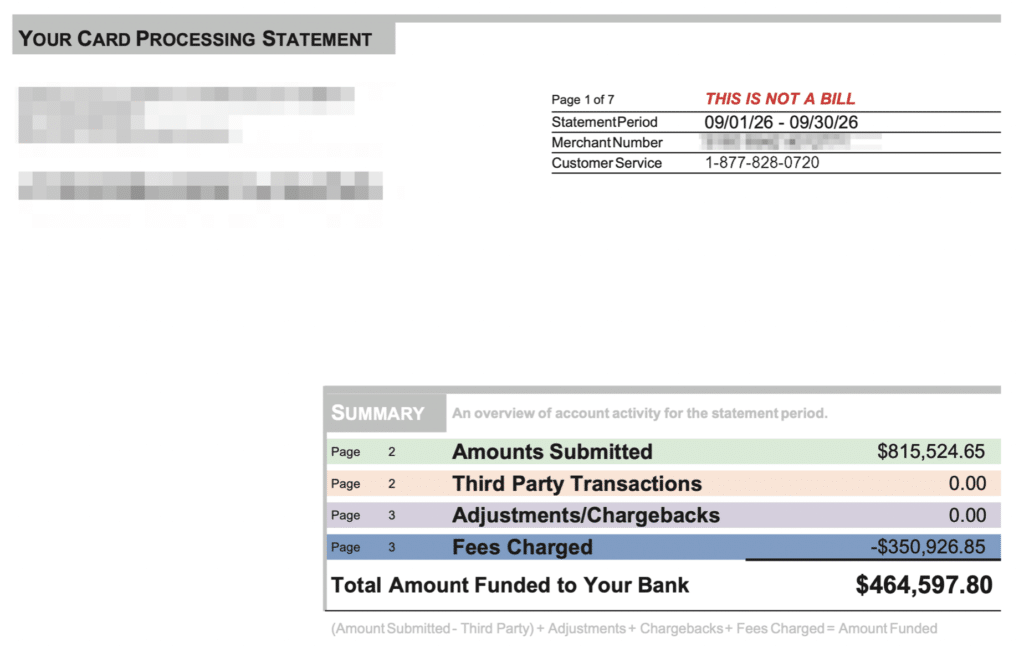
Exact numbers:
- $815,524.65 in volume
- $350,926.85 in merchant fees
- 43.03% effective
It’s the highest effective rate I’ve ever seen in my life.
In a normal month, a business of this size pays somewhere in the high $20,000 range to mid-to-high $30,000s. But this month, more than $400 for every $1,000 processed on cards went back to the processor.
Yes, it’s an error. But it still happened.
The Wrong Rate and Misplaced Decimal
If we look closer at the statement, we can identify the lines representing the processor’s markup. Fiserv is itemizing their markup “Other Volume Fees” that get charged as a percentage of the total volume for each card type.
Not the most clear or transparent way to identify markup, but that’s a different conversation entirely.
On this statement, Fiserv applied a rate that was 40% across every card type:
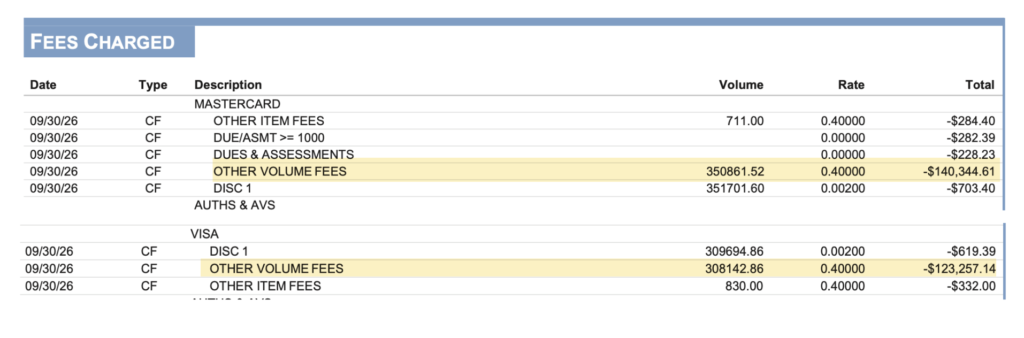
The rates are all written as decimals. And the math checks out on the DISC 1 line of 0.00200, which is 0.20%. But the other volume is listed as 0.40000, which is 40% under that same conversion.
And to top it off, this merchant’s rate isn’t even supposed to be 0.40%.
We just negotiated a 0.10% rate for them that went into effect on July 1, 2026. That rate was for Visa, Mastercard, and Discover. Though Fiserv insisted on charging 0.40% for Amex.
So for Amex, 0.40% was entered as 0.4000 instead of 0.0040, moving the decimal two places.
But for Visa, Mastercard, and Discover, the wrong rate went in and the decimal was wrong. Those card types shouldn’t have had a 0.40 rate anywhere near them.
Fiserv Acknowledged the Error (Eventually)
The $350,000 left the merchant account on October 1st. Fiserv typically doesn’t generate a statement until the 4th.
And the notice acknowledging a known funding error didn’t get sent out until October 6th.
That’s nearly a full week of a business looking at its bank balance with a third of a million dollars missing and no explanation from the company that took it.
To Fiserv’s credit, they didn’t dispute anything and plainly stated that month-end fees were calculated at a higher amount than intended.
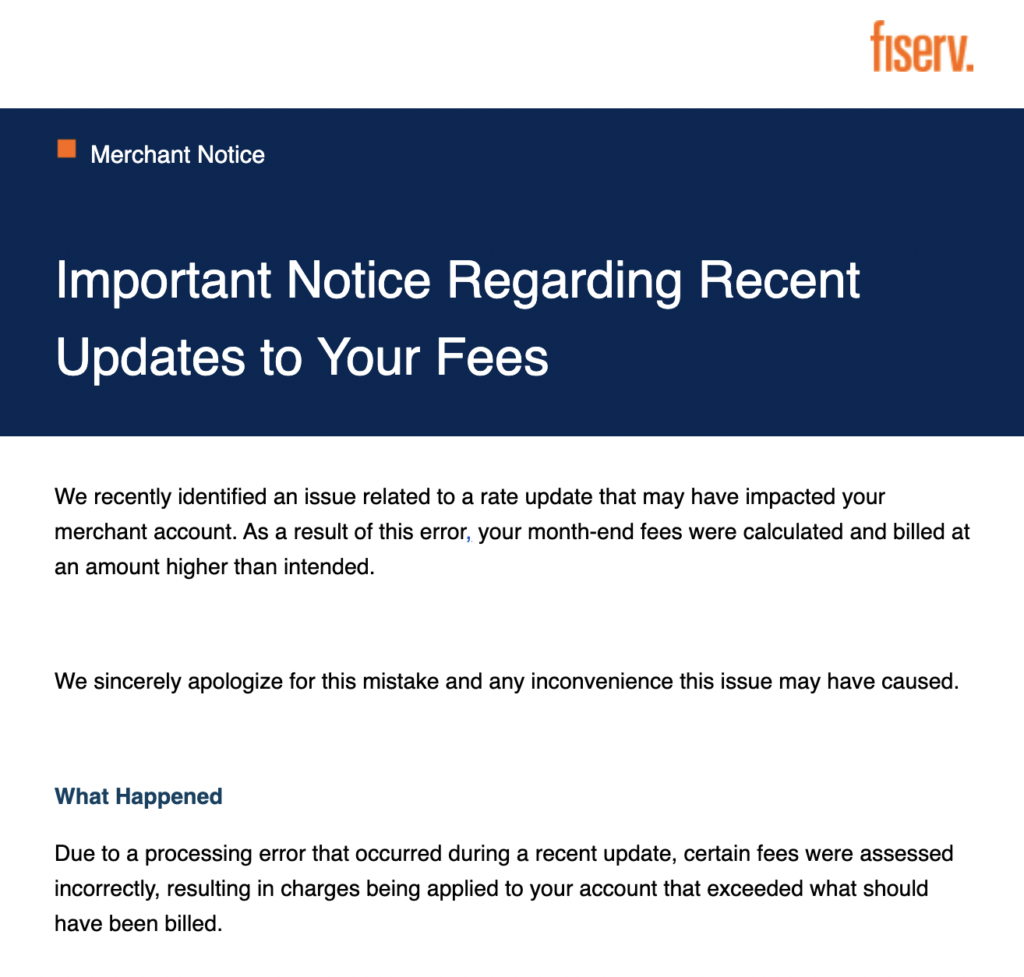
They apologized and put forth a three-point action plan to resolve the problem:
- If the debit went through, the merchant gets credited the overcharge.
- If the merchant’s bank rejected it, the incorrect amount gets written off.
- After that, Fiserv submits a new ACH debit for the amount that should have been charged.
The notice continues to say that Fiserv is going to complete those actions on October 7th. But the money likely won’t move instantly.
So you’re looking to get made whole likely on either the 8th or 9th. More than a week after the funds were incorrectly pulled.
Getting the Money Back Doesn’t Undo the Damage
Yes, the merchant gets the money back. But that’s beside the point (of course they would get their money back with an error like this).
But someone at this business still had to notice that vast sums of money were missing from the bank account, trace where it came from, reach out to the processor, reconcile every credit and then re-debit once everything posts.
That’s days of work that nobody planned for. All to clean up a mistake they didn’t make.
Oh yeah, and their operating cash is $350,000 short.
- Payroll has to go out
- Vendors need to get paid
- Rent is still due
None of this stuff gets put on hold because your processor made a mistake.
Fiserv’s notice made a point to say “no further action is required” which is almost laughable when you consider the amount of scrambling an affected merchant has to do behind the scenes when hundreds of thousands of dollars go missing for over a week.
And I’m genuinely not trying to attack Fiserv here. Just calling it how I see it.
I’m all for processors making money because they provide an important service and should be profitable. But when a pricing update can pull that much money from a customer’s account incorrectly, simply refunding it a week later isn’t enough accountability.
The Errors You Won’t Notice
Everyone notices $350,000 missing from their bank account. That’s maybe the only good thing about an error like this.
The bigger challenge is the version of this mistake that nobody catches.
We’ve seen statements on a smaller scale where the effective rate was 5% or 6% when it should have been below 3%. There’s no huge withdrawal here and no alarming email. Just a fee total that looked a little high and kept being paid every month.
Those are the errors that don’t cause anyone to panic. But they’re arguably more damaging because you’re dealing with cash flow constraints for months until they’re caught.
If a processor can misplace a decimal at this level, they can certainly make smaller errors too. And we know from experience that this stuff happens all the time.
Why Statement Audits Matter (Even When Nothing Looks Wrong)
Taking a step back, you can see the error right on the statement. The rate column said 0.4000, and that looks like a reasonable number. Unless you know how that column is formatted and you compare it to the rest of the statement, nothing really stands out apart from the amount being pulled.
That’s why statement audits are so important.
It’s not just about whether a fee is listed. You’re also assessing whether that number is being billed correctly and if the match matches what you agreed to pay.
Most errors won’t be as obvious as a 43% effective rate. And that’s exactly why someone should be checking.
Final Thoughts
Look, things happen. Someone at Fiserv keyed in the wrong rate and it was genuinely an honest mistake as opposed to something malicious. I’ve seen processors intentionally do far worse.
But what I don’t understand is how this gets all the way through. This shouldn’t have happened for several reasons.
Fiserv’s systems should have caught an obvious anomaly like an effective rate jumping from 3% to 43% overnight. They closely monitor merchants for risk, but their own internal billing apparently didn’t get the same scrutiny.
Additionally, this one debit was over 10x more than the normal monthly fee, which should have triggered something at the bank to stop it.
When you sign up for merchant processing, you authorize the processor to pull fees directly from your bank account. But up to what amount? Apparently there was no limit on what could be pulled here. This merchant’s fees normally run in the $20,000s to $30,000s per month. And if the rate had been off by one more decimal place, would a $3 million debit have gone through?
None of this is the merchant’s fault, but any alleged safeguards clearly didn’t work at this time.
If you haven’t had your processing statements reviewed recently, whether it’s with Fiserv or anyone else, reach out to us. We’ll go through everything line by line and work with your current provider to fix it if anything looks off.