 by Matt Rej


FraudSight is Worldpay’s fraud detection platform, which is now being sold to merchants using Global Payments. It’s an optional solution that costs:
- $0.05 per transaction
- $19.95 monthly minimum per MID
The problem is that merchants are being auto-enrolled in the platform for “free.” And then when the trial expires, they start paying for something they never actually signed up for and may not even need.
Anyone using Global Payments or Worldpay needs to be aware of this.
Whether you landed here from a free trial enrollment notification or you spotted new FraudSight fees on your statement, I’ll explain everything you need to know about the costs, charges, and how to get the fee removed from your merchant account.
Watch Out For a FraudSight “Free Trial” Notice
Global Payments has been notifying merchants that they’ll be enrolled in a free trial of FraudSight starting in September 2026, with an opt-out deadline of October 23, 2026.
If you miss that date, the trial converts on its own. You become a paying customer simply because you overlooked a notice. Even if nobody at your business confirmed, you’ll be charged automatically if you don’t opt out.
We haven’t seen this notice land on every Global Payments account just yet. So I’m not going to call it a portfolio-wide rollout.
But it should be treated as an early warning, and your account may not be targeted for a couple more months.
Just make sure you check all of your emails and notices attached to your monthly statement. We typically find a large portion of merchants get caught by programs like this because they never saw the initial notification, and they don’t catch the fees until much later after they’ve already been charged thousands of dollars.
This is Not a New Play
While Global Payments has been known for similar auto-enrollment fees over the years, this specific free trial tactic for FraudSight was taken directly from Worldpay’s playbook, even before Global’s acquisition of Worldpay.
Check out this notice attached to a Worldpay statement from back in June 2025:
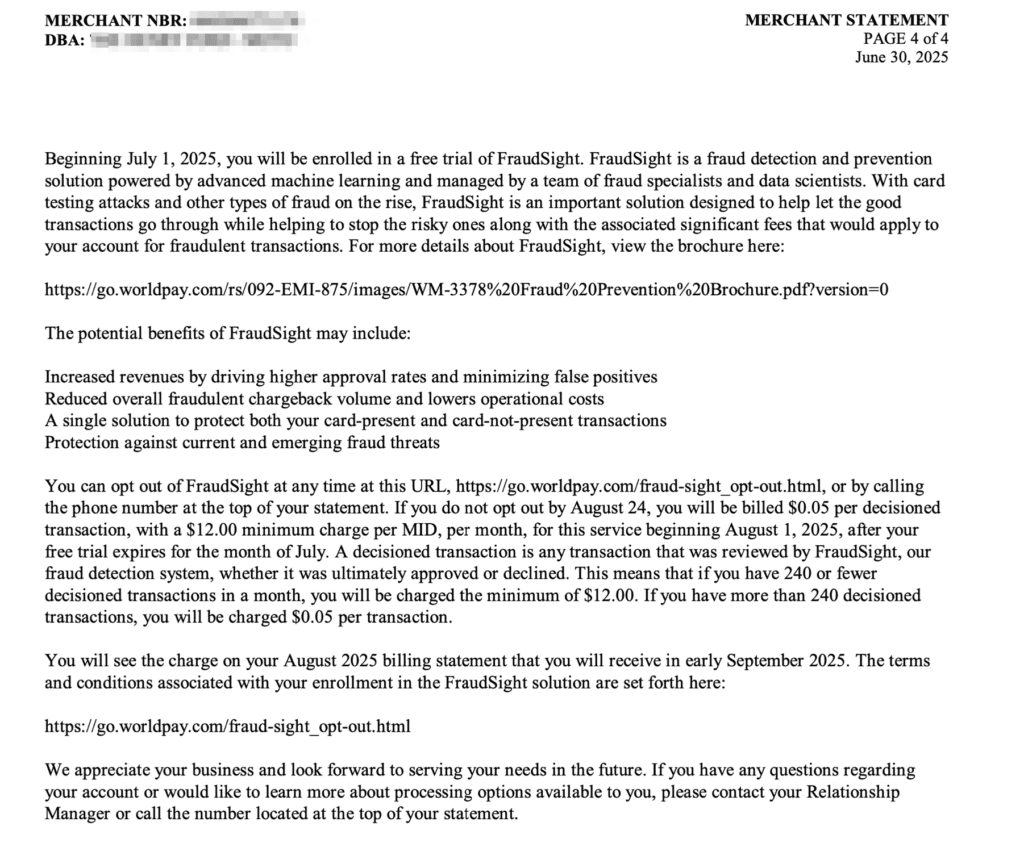
In this case, the effective date was July 1 and the opt-out deadline was August 24. But it’s the exact same structure. The language and model is essentially identical to what we’re seeing on the latest round of notices coming from Global Payments.
It’s also worth noting that the old FraudSight monthly minimum was $12 per MID a year ago. That number has jumped ~66% to $19.95 per MID.
Even though FraudSight is still technically a Worldpay product and Worldpay operates under its own brand name even after the acquisition, merchants using either provider need to pay attention to this.
Pricing rollouts can be done in waves. So even if you haven’t been enrolled in the free trial yet and don’t see any FraudSight fees on your statement, it doesn’t mean your account is immune. Any other subsidiary of Global can be targeted by this, too.
FraudSight Fees
- $0.05 per transaction
- $19.95 monthly minimum per MID
At first glance, it may not seem like much to lose sleep over if you’re getting charged $19.95 per month for a fraud solution that may be genuinely useful. But if you dig into the details of the billing structure, FraudSight is more expensive than you may initially realize.
$19.95 per month is the floor, and that’s charged per merchant ID. Say you have 30 locations and each has its own MID, you’re going to pay ~$600 per month and over $7,000 per year.
But the $19.95 fee may be largely irrelevant if you process 400+ transactions per month.
How Much FraudSight Fees Could Cost You
Even a small business can easily exceed that 400-transaction threshold. And high-volume mid-market or enterprise sellers can blow it away.
You can see how this quickly gets expensive at scale.
- 640 monthly transactions: $32 per month, $384 annually
- 1,850 monthly transactions: $92.50 per month, $1,110 annually
- 4,200 monthly transactions: $210 per month, $2,520 annually
- 9,400 monthly transactions: $470 per month, $5,640 annually
- 22,000 monthly transactions: $1,100 per month, $13,200 annually
A high-volume ecommerce merchant could easily be paying an extra $20k to $30k or more in FraudSight fees every year. All because they were auto-enrolled into a free trial of something they never asked for.
It’s also worth noting that the per-transaction element actually means “per decisioned transaction,” which is a subtle but noteworthy difference. Because a “decisioned transaction” is any transaction that was reviewed by FraudSight, whether it was ultimately approved or declined.
Every card run is a billable event once you’ve been enrolled. Not on fraud it catches or chargebacks it prevents. Everything running through your system counts.
What FraudSight Does
The product itself isn’t inherently bad. FraudSight’s technology uses machine learning and a rules layer to score transactions in real-time, returning a score between 0 and 1,000.
Based on the thresholds you set, the transaction either gets approved, declined, or routes to a manual review queue. And it covers both card-present and card-not-present volume.
There are two tiers:
- Protect: Built for merchants without an in-house fraud team. Worldpay/Global manages the fraud strategy on the merchant’s behalf, including real-time decisioning, fraud scoring, reports, device data, and behavioral data. Custom rules and manual reviews are optional.
- Premier: Designed for businesses who manage fraud internally. It adds a consulting desk, fraud dashboards, and custom rules as the standard deployment.
FraudSight can be set up to run either:
- Pre-network that screens the transaction before going to the card brands
- After the authorization comes back from the network
On post-network declines, Worldpay reverses the authorization on the merchant’s behalf. All of the device and behavioral data comes through a JavaScript snippet on the checkout page (powered by ThreatMetrix).
One thing that’s genuinely cool is that there are no additional integration requirements to use FraudSight. A flip gets switched on the processor’s side, and it starts running.
Do You Actually Need FraudSight?
FraudSight is a legitimate fraud product with real machine learning behind it. So it’s not a pure junk fee.
For the right merchant, there’s definitely a place for it. But that’s a totally different question from whether you should be paying for something because you overlooked an auto-enrollment email.
It may be worth the money if you:
- Run a large volume of card-not-present or ecommerce volume
- Currently absorb actual fraud costs (not hypothetical ones)
- Have chargeback issues or fraud ratios climbing toward VAMP thresholds
- Are getting hit with card testing attacks
- Don’t have any other fraud tools in place
Even if your business could actually benefit from FraudSight, you need to make sure that you’re not buying something you already have. There’s a chance your gateway might have fraud filters bundled or you might be paying for something like 3D Secure or an authentication service.
Dispute deflection tools like Visa Verifi, RDR, or Order Insight also fall into this category and you may not need to be dealing with fraud from so many different angles if it’s not a legitimate widespread issue for you.
FraudSight probably isn’t worth the money if:
- You run card-present transactions almost exclusively
- You already pay for fraud tools (like the ones mentioned above)
- You never have fraud-related chargebacks
Here’s a simple way to figure this out. If nobody at your company can explain what FraudSight is doing for your business and attach a real value to it, then you likely don’t need it.
How to Opt Out
The free trial notification should come with detailed opt-out instructions with a dedicated opt-out page. You can also call the phone number at the top of your merchant statement.
Just make sure you:
- Opt out for every MID
- Call your rep to process in bulk if you have lots of MIDs
- Get confirmation in writing
- Verify that you’re not being charged for anything after you’ve opted out
Unfortunately, you can’t assume that your phone call alone actually worked. Even if you received an opt-out confirmation email.
We see this all of the time. Billing “mistakes” happen, and you still might get charged. So you’ll need to continue monitoring your statements in the coming months to ensure you’re not being hit with FraudSight fees you didn’t agree to pay.
What Happens if You Miss the Free Trial Opt Out Window?
If you miss the opt-out deadline, you’re officially a paying customer of FraudSight.
Billing starts the month after the trial ends. So you won’t see it until the statement for that month arrives (which comes the following month).
To find this on your statement, skip over the interchange detail and look for monthly fees, other fees, service fees, or value-added services. It won’t always be obvious so you’ll need to go line-by-line.
It’s also worth noting that the line item may not be obvious.
The billing descriptor could be any variation or abbreviation of “fraud.” But if it’s being charged at a flat $19.95 per month for MIDs with less than 399 transactions or $0.05 per transaction for those above the threshold, that’s the fee.
How to Get FraudSight Fees Removed From Your Statement
FraudSight is an optional service. So you don’t have to pay, and shouldn’t have to pay if you don’t want or need it.
Even if your free trial has expired and you’ve already been getting charged, you can still opt out by contacting your processor and telling them to remove the service and all applicable charges moving forward.
You can also request a refund in the form of a statement credit for any fees you paid after the trial expired.
There’s no guarantee that your request will be honored. But you should push for it, and ask for concessions elsewhere if they don’t credit you.
That’s when it helps to have a merchant consultant handle these negotiations on your behalf. In addition to removing the FraudSight fees, our team here at MCC can also negotiate directly with Global Payments or Worldpay to lower your overall processing fees. Whether that’s getting your discount rate lowered or other fees removed, you can save thousands every month without changing anything.
Final Thoughts
FraudSight is one of the cleanest examples of what’s happening right now in the processing industry with rising costs associated with value-added services (VAS). Processors are looking for more ways to charge merchants beyond core processing. So they’re coming with different tools that they can sell.
There’s nothing wrong with this, and fraud detection solutions from your processor can be genuinely useful.
The problem that I have with FraudSight is how Global and Worldpay are going about it.
They’re not sending out email notifications to inform you about a service you can optionally add on. Or having sales reps call to pitch you on the service.
You’re being enrolled automatically, without consent, in something that appears to be free or carry a negligible cost once the trial expires.
That’s not right. And if you simply overlook a notice or don’t understand the details, you could end up paying thousands in extra processing fees for a service that you don’t want or need.
Keep a close eye on your statements for this notice or new charges. If you want, let our team here at MCC take a look at your statements for free to see if anything fishy is happening.