 by Matt Rej


When your credit card processor sends a notice that rates are going up, it’s easy to assume that every other business using that processor is getting the same increase.
But that assumption is wrong.
While processors definitely roll out broad pricing changes across their entire merchant portfolios, sometimes they also target individual businesses with pricing changes.
This distinction is important because non-universal rate increases can be easier to negotiate. Which means your latest rate increase notice is not set in stone.
Types of Credit Card Rate Increases
Most rate increases or pricing changes fall into one of the following three categories:
Card Network Changes
These are non-negotiable prices set at the network level by Visa, Mastercard, American Express, and Discover.
Networks periodically update interchange rates, assessments, and other card brand fees. Your processor doesn’t control these underlying costs, but they’ll often notify you of potential changes ahead of these updates. The biggest changes usually happen in April and October, but smaller changes and specific program updates can happen any time throughout the year.
It’s worth noting that some of these changes do impact certain merchants and not others, as a new fee may only apply to certain card types, transaction environments, industries, or qualification criteria.
But all of this is established by the networks. Your processor isn’t deciding that Merchant A should pay a particular Visa assessment while Merchant B is exempt from the same qualifying transaction. That’s very different from a processor increasing its own markup.
Processor-Wide or Broad Portfolio Increases
Unrelated to the network changes, processors can also raise their own markup. This is everything that they charge on top of interchange.
These types of pricing updates can be presented as discount rate increases (bps markup on every transaction), per-authorization or per-item fees, percentage-based fees on a portion of your volume, or monthly, annual, and one-off fees.
Most of these changes are relatively straightforward. Elavon increasing its rates annually portfolio-wide for the last five years in a row is a clean example of this.
Other broad increases don’t necessarily hit every account at the exact same time. For example, Fiserv increased rates by 0.10% + $0.10 per transaction for one group of merchants last September. And then another group received the same exact increase in November. We’ve seen North do similar things over the years, with pricing changes rolled out to different groups of merchants at different times.
So just because another merchant using your processor didn’t receive an increase at the same time as you doesn’t automatically mean yours was account-specific. They could just be part of a different wave.
Targeted Account-Specific Rate Increases
The third type of increase doesn’t get nearly as much attention as the others. It’s when a processor raises rates arbitrarily on a single account or small portion of accounts that clearly aren’t being applied equally.
We’ve seen this plenty of times from multiple processors.
For example, two different clients of ours both received rate increase notices from TSYS about pricing changes going into effect at the same time. One account was increased by 0.55%, while another was increased by 0.65%. Same processor, different increase amounts. And other merchants using TSYS weren’t impacted at all.
Most businesses don’t realize if they’re dealing with this type of increase because they have no way of accessing pricing or notifications from other merchants.
Why Would a Processor Increase One Merchant More Than Another?
There’s no formal justification for targeted increases. Your processor may be managing millions of merchant accounts, and individual reps or account managers have discretion over the rates on the accounts they oversee.
Some of those reps use that discretion aggressively by testing how large of an increase they can apply on certain accounts.
They may look at your account and see that you’ve never once complained or pushed back when a new fee was added or during a portfolio-wide increase. So if they raise rates on just your account, they’re hoping you’ll just accept those terms again.
But there’s no single reason why this happens, as we’ve seen it across the full spectrum of account types.
- High-volume and low-volume businesses
- Single and multi-location merchants
- New accounts and merchants that have been with the same processor for 10+ years
- Every industry
There’s no pattern because there’s no real predictable criteria being used. It’s just a person deciding how much they want to take from your account.
A Massive Increase Should Immediately Raise Questions
When a processor sends a blanket increase to every account in their portfolio, the numbers tend to be modest. Anywhere from 0.05% to 0.20% increases, while still meaningful, tend to be standard territory for broad pricing changes.
That’s because these types of increases need to hold up across tens of thousands of accounts simultaneously. If it’s too aggressive, too many merchants will push back at once.
But a targeted increase doesn’t have the same constraint.
We recently came across a notice from Global Payments informing one of our clients that their discount rates were increasing by 2.25% effective August 2026.
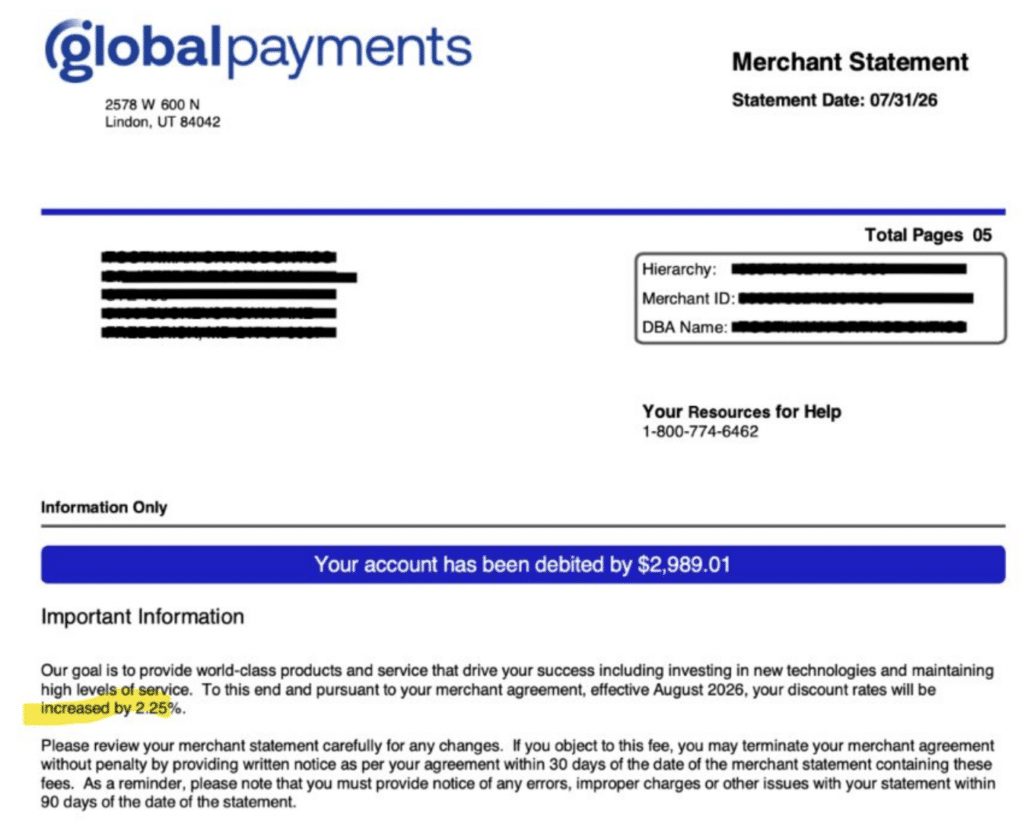
Yes, you read that correctly. A 225 basis-point increase. Translation: an extra $22,500 for every $1 million processed.
Whenever you see an increase this large, it should immediately raise a red flag.
That amount alone is higher than the total effective rate that other merchants are paying right now (we know other businesses paying 2.18% total).
This is not a blanket policy increase. And none of our other clients using Global received a notice for that account.
It’s also funny how Global uses boilerplate language about “investing in new technologies and maintaining high levels of service” as justification for such a wild increase. That doesn’t mean anything. And they literally charge other annual System Enhancement Fees and Infrastructure Upgrade Fees that are allegedly supposed to cover those same costs.
How Do You Know if the Increase Applies to Everyone?
You can’t always know with certainty if a notice is specifically targeting your account, but there are several things worth looking at that can be telling.
What is Actually Increasing: Read the notice carefully. Is it a discount rate, per-transaction fee, service fee, network assessment, or interchange update? Broad language that lists several types of fees without specifying exact amounts for each is often a signal that the change isn’t being applied universally. If your notice just vaguely says that certain types of fees “may” increase without actual numbers, it’s likely because those amounts will vary by account.
Size of Increase: This is often the biggest tell of all. If it’s a 0.05% or 0.10% increase to your discount rate or a specific type category, then it’s plausible everyone using the same processor will be impacted. That doesn’t mean it’s non-negotiable, it just means that you aren’t the only one being hit. Larger increases (like 2.25%) almost certainly aren’t being applied to everyone.
Timing: Look back at the timing of your last increase and the last broad increase from this processor. If it’s been well-documented that your processor raises rates annually around June or July and your notice aligns with that, it’s probably for everyone. But if your rates went up six months ago and now you’re getting hit with a second increase in less than a year, it’s worth a closer look.
Ask Your Processor Directly: Reach out and ask point blank whether this increase is being applied to all merchant accounts or to your account specifically. You may not get a straight answer, but asking the question lets them know you’re paying attention, and that alone can change the conversation.
Get a Second Set of Eyes on Your Statement: One of the benefits of working with a merchant consultant like MCC is that we have access to statements and pricing from other businesses using processors. So we can tell you directly whether your account is being targeted or if everyone’s rates are also going up. In either scenario, the increase is not set in stone.
Non-Universal Rate Increases Give You More Negotiating Leverage
If an increase is genuinely being applied across every merchant account under management, you can still negotiate but your options may be a little more limited. It’s still worth pushing back and there are plenty of ways to get relief, but you’re working against a decision that was made at a higher level.
But that dynamic flips when an increase targets your specific account.
Non-mandated pricing changes that weren’t universally applied only exist because someone decided to apply it. Those decisions can be undone if you ask the right questions.
It’s even more powerful if you come to your processor with proof that other merchants weren’t hit with the same increase or they were hit with a lower amount. When you bring this to the negotiation table, your processor can’t say that “everyone was affected” or “there’s nothing we can do” because it’s clear neither of those things are true.
This concept even applies to processor fees beyond the discount rate. For example, Elavon added a Non-Qualified Volume Fee to one of our client statements. We knew that this fee wasn’t being universally applied to other accounts, so we reached out and got it removed.
Don’t Treat Rate Increases as Unavoidable Costs
Regardless of whether the increase was applied just to you or to everyone, the biggest takeaway here is that you shouldn’t accept pricing changes without a fight.
At minimum, reach out to your processor immediately and ask for them to waive the change on your account. You’ll likely be told some version of “nothing can be done.” But it’s a starting point.
From there, you can look for more justification that the increase is unwarranted. Whether it’s the timing compared to your last increase or proof that the change isn’t being applied to everyone, it gives you more leverage when you come to the negotiation table with real reasons.
That’s when it helps to have a merchant consultant in your corner. Here at MCC, we handle all of the negotiations on your behalf, and we have the proof needed to show that your increase is completely arbitrary.
Our service is structured so we share a percentage of your savings. So we only get paid if you save money. Book a free consultation today.