 by Matt Rej


Businesses expect a discount on credit card processing at a high volume. And it’s often deserved. When you’re processing millions per month, your processor can charge you less and still earn plenty of money based on volume alone.
So what’s considered high volume? And what type of rate can you expect to get when you’re at a certain level?
It depends on a lot of factors, including your processor, card mix, industry, and transaction volume.
But to give you some context, I’ll show you a Worldpay statement from a grocery chain processing over $39 million in a single month across 907,619 transactions.
$39.7 Million in a Month With No Discount Rate
One of the first things most people look for on a merchant statement is the discount rate. That’s the percentage the processor charges on top of the wholesale interchange and network costs.
On this particular high-volume merchant statement, there isn’t one:
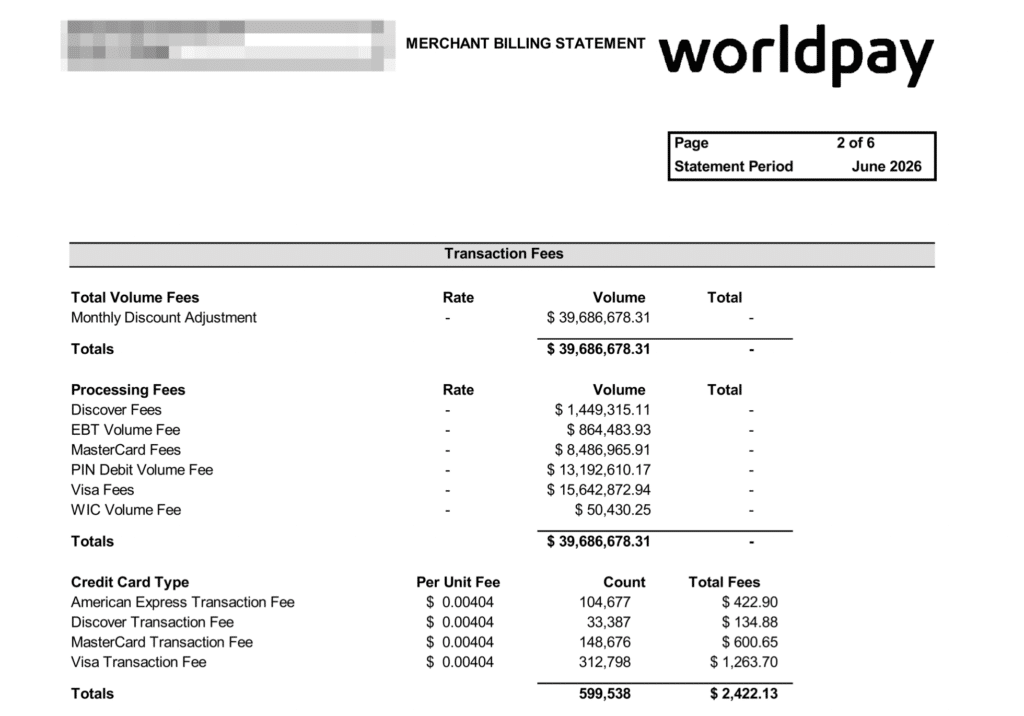
As you can see from the processing fees summary, the rate is blank for every line, as is the totals column.
Instead, Worldpay charges a flat $0.00404 per transaction on every card type.
Yes, you read that right. This markup starts at fractions of a cent (about four tenths).
What it Takes to Get High-Volume Pricing Like This
Volume is what gets a merchant into this conversation. But it’s far from the only thing a processor looks at when underwriting an account and setting rates.
This merchant checks nearly every box a processor looks for:
- It’s a grocery chain, which is one of the lowest-risk merchant categories out there.
- Nearly all sales are in person (card present).
- Chargebacks are almost non-existent (this month there were 4 of over 900k transactions).
- Average ticket is around $50, so a per-item fee still adds up on transaction count.
- About a third of the volume is PIN debit.
- Every store in the chain is also running processing through the same processor, meaning Worldpay is actually getting much more than $39 million per month in volume from this merchant.
If you change any of those details, the price will be adjusted, too.
For example, a $40 million monthly ecommerce business definitely won’t see four-tenths of a cent and no discount rate. With a profile like that, every sale is card-not-present, which is more expensive to process and carries a higher chargeback exposure. Decline and retries also mean more authorizations per completed sale, and fraud tools will usually get bundled in too.
Ticket size is another important variable to consider here. B2B merchants with a $2,000 average ticket doing the same $40 million volume runs about 20,000 transactions (vs. 900,000+ transactions for the grocery store). So there would certainly be some type of percentage component added here.
The Rest of the Processor Markup at High Volume
That per-transaction fee isn’t the only thing that this merchant is paying to Worldpay, though.
If we continue auditing everything, there are more line items that stand out both in the Other Fees section of the statement:
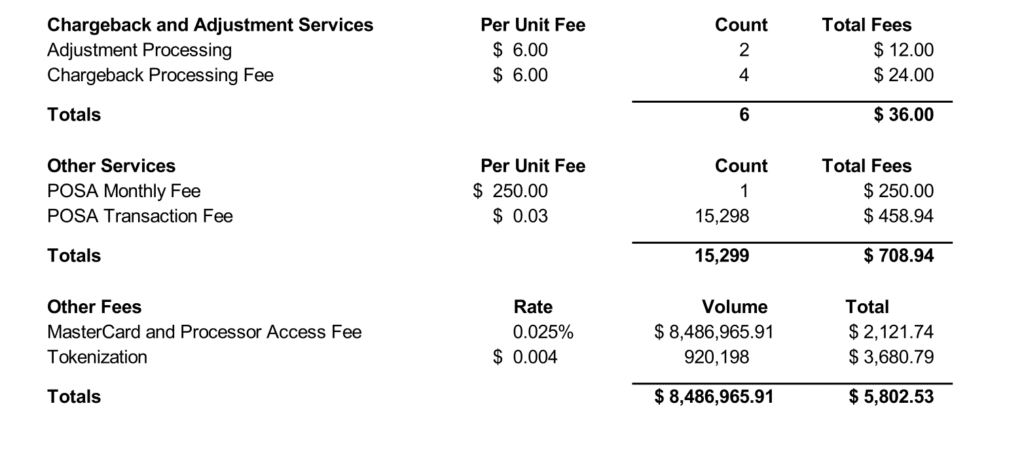
Tokenization fees totaled $3,680.79, which is about $0.004 per token.
This is a Worldpay service that’s labeled cleanly, and it’s tied to a legitimate service. And for a grocery chain it’s probably worth paying for because tokenizing card data reduces PCI scope. Plus, $0.004 per token is cheap.
But the Mastercard and Processor Access Fee charged at 0.0025% of Mastercard volume is worth closer scrutiny. It’s $2,121.74 for this month, and the origin is harder to pin down.
The name itself reads like a card brand fee and the “access” closely echoes Mastercard’s Network Access and Brand Usage Fee. But NABU is billed separately and not charged as a percentage. And this fee sits in Worldpay’s section, separately from the network fees.
It looks like it covers Mastercard’s Acquirer License Fee, which doesn’t appear anywhere else on this statement. Plus some margin added for Worldpay.
The rest is small. Gift card activation (POSA) ran about $700. Add chargeback handling, and other miscellaneous charges for another ~$500ish.
Where Processor Fees Hide on a High-Volume Statement
There are two more Worldpay charges that don’t show up in the processor section at all. They’re both in the “Third Party Credit Fees” portion, grouped with other network assessments:
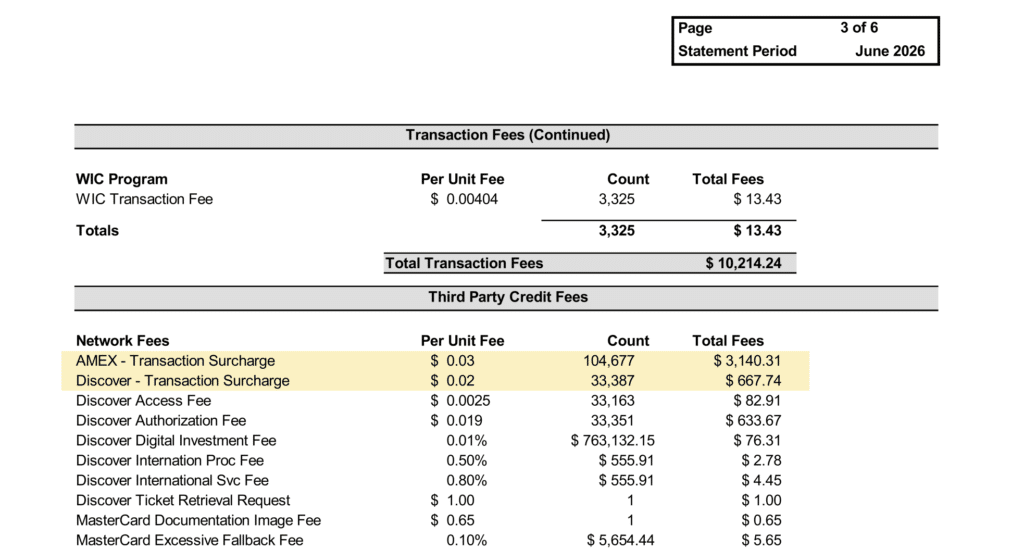
The first is an Amex Transaction Surcharge Fee billed at $0.03 per transaction on 104,677 sales. This merchant is on a direct agreement with American Express, which is required once you pass the $3 million annual OptBlue threshold. So Amex sets its own pricing but Worldpay still authorizes and routes the transactions, and they’re charging for that service.
And the second is a Discover Transaction Surcharge billed at $0.02 per transaction on 33,387 Discover transactions.
Together, these two lines total $3,808.05 in additional processor revenue sitting in the pass-through fee section.
It doesn’t make this a bad deal. But it shows that even at this level, there are going to be extra processor markups buried in places you don’t expect them to be.
Worldpay’s Take Comes Out to About 1.6 Cents Per Transaction
All-in, and Worldpay collected $14,494.17 from this merchant in June. Here’s what that breakdown looks like:
- $3,666.77 in per-transaction fees across every card type (including PIN debit, EBT, and WIC)
- $3,680.79 in tokenization fees
- $3,808.05 in Amex and Discover surcharges
- $1,216.82 in smaller service charges (BIN, virtual terminal, POSA, etc.)
That’s roughly $0.016 per transaction.
Everything else on the statement card brand assessments, network fees, and interchange.
This one of the best-priced accounts that you’ll ever come across. And as much as I’ve given Worldpay a hard time in the past for some questionable billing tactics, they definitely aren’t taking advantage of this merchant.
Are a few fees labeled in ways that make them look like something else? Sure.
So even with high-volume processing, the all-in processor markup ends up being about 4x higher than the initial headline rate ($0.004 vs. $0.016). Which is common in any statement. The difference here is that the 4x amount is still pennies overall, and the merchant is getting a great deal.
What This Means for High-Volume Merchants in the $1 Million, $5 Million, or $10 Million Monthly Range
If you’re running $2 million per month in card sales, you’re only doing about 5% of this grocery store’s volume. And this is just one of their locations in the chain.
$2 million still gives you leverage, but it won’t get you four-tenths of a cent and no discount rate.
But it’s still good to see how volume plays a role in the big-picture negotiation process. In another Worldpay statement audit I covered, a merchant processing about $276,000 per month was paying a 0.10% Network & Processor Access Fee on all of its volume, plus 0.10% for tokenization. Whereas this high-volume grocery paid 0.025% on Mastercard only, and $0.004 per token.
Merchants sitting somewhere between these two extremes should land somewhere in the middle.
Doing $10 million in card sales per month definitely warrants a better rate than a merchant with a similar profile doing $1 million.
But you’re still going to be far off from someone running $40 million at just one location. Especially when you factor in the card mix and risk profile.
If you think you’re a high-volume merchant and deserve a better price on credit card processing, talk to our team here at Merchant Cost Consulting. We can help you negotiate a cheaper rate directly with your current processor, at a discount that your volume deserves.