 by Matt Rej


Your credit card processor is not your partner. They’re a vendor with a margin to protect. And the less you understand about how you’re being charged, the better it is for them.
Keeping you in the dark helps ensure your account stays profitable. They bank on your complacency, and this strategy often works well because most merchants don’t question anything.
Here are some secrets they don’t want you to know about. It’s all leverage you can use to identify overcharges and secure better rates.
1). Your Rates Are Negotiable
Most merchants don’t attempt to negotiate their credit card processing rates after the initial contract is signed. And that’s a big mistake.
The main reason behind this is because they don’t realize it’s an option.
Even if you signed a “good deal” years ago, there’s a high probability your rates have crept up over time. Between annual increases, new fees, and other margin buried in places you don’t think to look, you could save thousands every month by simply picking up the phone and negotiating better terms with your processor.
On average, our statement audits reveal opportunities to reduce processing costs by about 28%.
2). So is Your Billing Structure
The way your processor charges you is equally important to the rate, as certain billing structures are designed to work against you:
Sales reps sell you on the simplicity of these setups because they’re easy to understand and sound like you’re getting a good deal. But in reality, processors push these on you because the profit margins are sky-high.
None of these models are transparent, and you’re always going to pay more than you would on an interchange-plus (IC+) or cost-plus model.
This is something else that can be changed with a simple phone call or email, without switching processors.
3). Monthly Statements Are Designed to Confuse You
Monthly statement summaries can have hundreds of line items across dozens of pages. They’re filled with industry shorthand, and presented in a way that’s incredibly difficult to understand.
It’s a tactic that we see used by almost every processor because if you can’t read your statement, you won’t know what you’re paying.
Most businesses have no idea which fees on their statements are going to the processor vs. networks or issuing banks. The lines are intentionally blurred to keep you guessing and assuming everything is mandatory.
Here’s a crazy one:
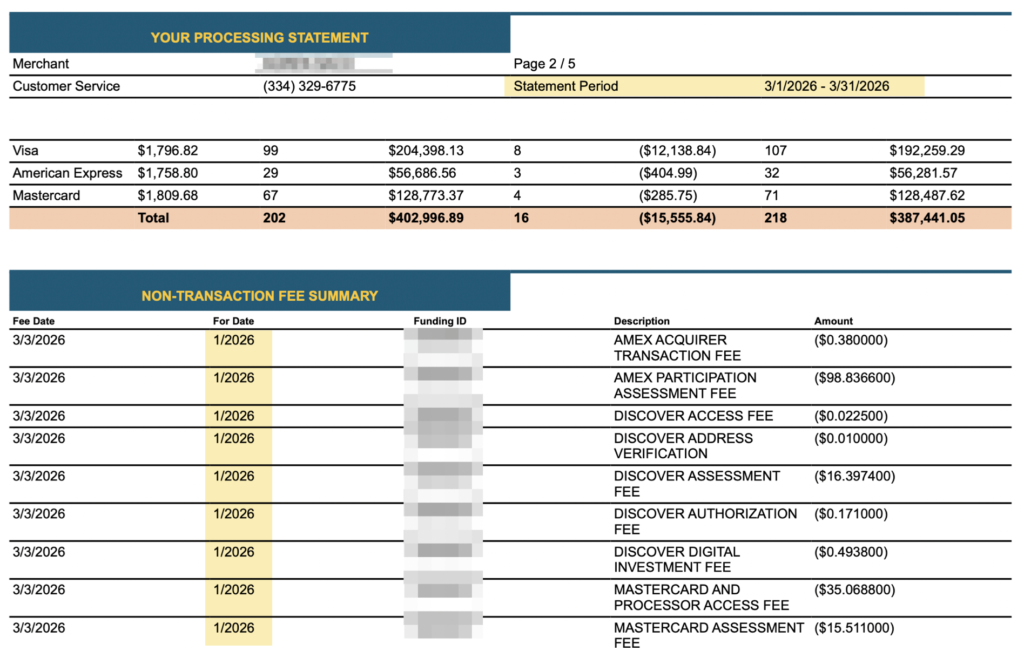
Statement is March 2026, and the summary by card type (top section) is for that same period.
But the actual fee breakdown below it is for processing activity in January 2026. This merchant won’t see March’s breakdown until their May 2026 summary arrives.
Statements are hard enough to read when you have all the information in front of you. This processor makes it even harder by requiring you to have three months’ worth of statements to understand your fees in just one period.
4). Their Markup is Unrelated to Interchange
Another deceptive strategy that we see used all the time is when processors hide rate increases behind interchange updates. They’ll use a network update or change as an excuse to raise your rates, even when the two are completely unrelated.
Here’s what you need to understand.
Interchange and assessments are pass-through costs set by the card networks (Visa, Mastercard, Amex, and Discover). Your processor’s internal costs don’t change when Visa raises an interchange fee or adds a new assessment category.
So when your processor sends you a notice along the lines of “Due to card brand changes…” followed by “your discount rate will increase by…”
It’s incredibly misleading.
They want you to think that the two are connected because network changes are non-negotiable. But a network increase is not an excuse for your processor to raise rates.
5). They’re Charging You More Than You Realize
Merchants will often think they’re paying a 30 bps markup or 0.10% + $0.05 per transaction. Whatever the headline rate is on the merchant agreement.
It may seem like a good deal, but your processor knows they can quietly pad their margin elsewhere if you’re online looking at the discount rate.
For example, here’s a merchant paying 0.10% + $0.10 per transaction:
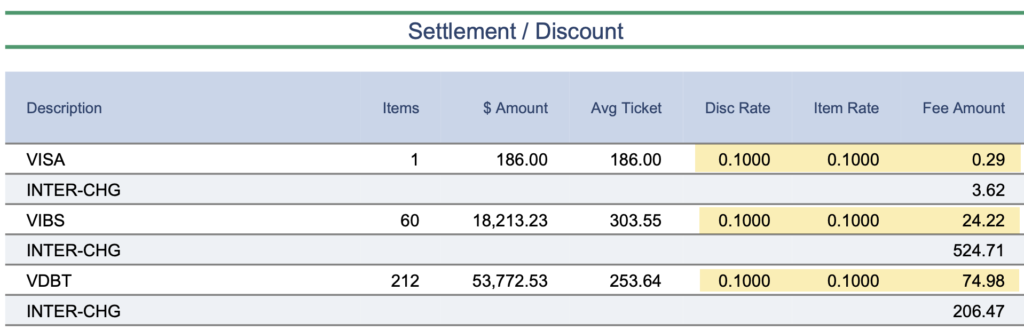
If they glance at their statement, they’ll see that it aligns with what they signed up for and assume everything is normal.
The statement looks transparent enough, as there’s the interchange amount and processor markup separated for each transaction type.
But as you continue through the pages, you’ll see some additional charges like this:
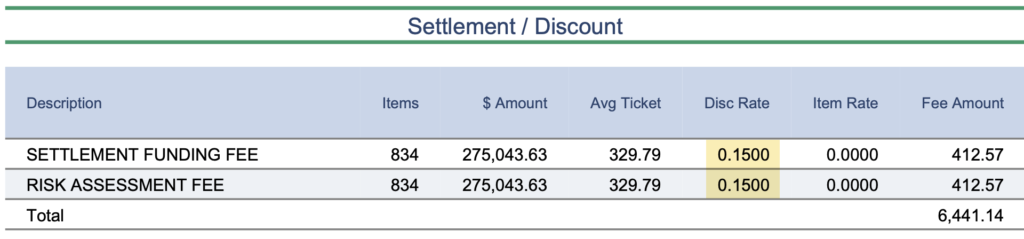
Terms like Settlement Funding Fee and Risk Assessment Fee both sound legitimate enough, right? So you may not question it.
But both of these are being charged 0.15% on the total volume, and they’re pure processor markup. So this merchant is not paying 0.10% + $0.10 per transaction. They’re actually paying 0.40% + $0.10 per transaction when you factor in these additional markups. That’s 4x what they thought.
While the exact fee names and how they’re applied vary by processor and merchant account type, we see this type of creative billing applied on statements industry-wide. And it’s all based on deception.
6). Being Under Contract Doesn’t Mean You’re Stuck
Some merchants eventually find out that they’re overpaying on credit card processing. But they’re halfway through a 36-month contract, and assume they can’t do anything about it until the term expires.
That’s typically not true.
There are usually provisions within your contract that allow you to change the terms at any time, especially if your processor changes anything (adding new fees, increasing your rates, etc.).
You can negotiate your rates at any time during your contract. And if your processor uses your contract length to stonewall you, there are other ways to leverage your position.
7). There’s No “Standard” Rate or “Standard” Fees
If you do get the courage to call or email your processor about your rates, the support rep will often say something like:
- “That’s our standard price”
- “Everyone has to pay it”
- “Those are standard fees”
None of this is true, and we know from first-hand experience.
The beauty of being a merchant consultant is that we can see statements from dozens of merchants using the same processor. So we can see how vastly different rates are from account to account.
The same processor may charge you 0.50% + $0.15 per transaction while another business could be paying 0.15% + $0.05 for similar volume.
Everything is customized and negotiable.
Same goes for all of the ancillary fees: PCI fees, risk assessment, security plus, annual service and maintenance, regulatory assurance, and so on.
The difference is that when we call the processor on your behalf, we have concrete proof that those fees don’t exist on other accounts and that other businesses are paying less. On your own, they tell you whatever they want and you’re often forced to just accept it.
8). Your Effective Rate is the Most Important Number (and They Don’t Disclose It)
The single most important number in payment processing is your effective rate. Yet it doesn’t exist on your monthly statement. That’s right. Of the hundreds of line items on your statement, your processor doesn’t give you the most telling number, and that’s by design.
Your effective rate is actually simple to calculate. It’s just your total fees divided by total processing volume.
The reason why it’s so important is because it accounts for everything:
- Discount rate
- Interchange
- Assessments
- Authorization fees
- All other processor markups
It’s the easiest way to track your costs over time, and the fastest way to determine if your processor is hiding margin somewhere in your statement.
If you’re supposedly paying 0.05% + $0.03 per transaction but your effective rate is 3.95%, there’s a problem. The mandatory network fees probably won’t exceed 2% for most card mixes. Which would mean there’s close to 200 bps of additional markup being charged by your processor somewhere else.
9). They Don’t Want to Lose Your Account
Onboarding is the most expensive part of handling a merchant account. But maintaining the account is easy, and extremely profitable.
Once you’re signed on, everything essentially runs on autopilot.
They profit every time you accept a card payment, and their success is dependent on this scale across every merchant account in their portfolio.
Churn is bad for your processor. So they’re willing to make concessions if they think you’re going to walk.
We typically don’t recommend switching processors because it’s cheaper to stick with your current one and just negotiate better terms. But the threat of leaving could help you secure a better deal.
10). Rate Increases Aren’t Necessarily Final
Annual rate increases have become the new normal in the industry. It’s reaching a point where you’re almost lucky if your processor only raises rates every 2-3 years.
It typically goes like this:
Your processor sends an email or attaches a notice to your statement that your rate is increasing on a specific date (usually 30-60 days out). If you object, you can terminate your account within 30 days.
The wording of these notices feel absolute. So most merchants just accept the terms because they don’t want to switch. But that’s how your rates quietly double, triple, or quadruple over the years.
What your processor doesn’t want you to know is that you can reject those terms. Just call them and say no.
It’s not always that easy, and there’s often nuanced negotiations involved and you may need to settle somewhere in the middle. But the initial number they send you is completely arbitrary and can always be negotiated.
11). They Won’t Tell You When You Qualify for Better Pricing
Over the lifetime of your account, there may be certain triggers that could land you a better rate, including:
- Significant increase in processing volume
- Stable business history
- Consistently low chargeback ratio
- Minimal fraud incidents
- No longer classified as high risk
For example, when you first signed on with your processor you might have been a new business doing a modest $100,000 per month in card volume. Fast forward three years, and you’re doing $1 million per month.
That type of volume warrants a rate discussion. But your processor is never going to pick up the phone and tell you that.
Even less dramatic business growth could qualify you for better terms. You have more leverage than you realize, and all you need to do is ask.
Final Thoughts
The biggest mistake you can make here is treating credit card processing as a fixed operating expense. Your processor benefits when you assume the price on your statement is simply the cost of doing business, and the reality is that is far from the truth.
Processing costs should be reviewed with real scrutiny. And knowing how the system works changes your position entirely.
You don’t need to switch processors or hire a lawyer to get a better rate. Sometimes all it takes is asking the right questions and being willing to push back.
If you’d rather not do this yourself, that’s what we’re here for. Contact our team here at MCC for a free audit today.