 by Matt Rej


Worldpay has been getting more aggressive with its pricing tactics.
It’s frustrating for merchants, especially if you’re among those getting an absurdly high rate increase notice (we’ve seen these as high as 200+ bps).
While looking for alternative credit card processors might seem like a logical fix, this isn’t realistic for many businesses. With payments fully integrated into your business operations, software, and reporting flows, changing processors would mean rebuilding everything from the ground up.
Even if you have standalone processing that would be a cleaner break, a new provider won’t automatically solve your cost problems.
Either way, you can save money on credit card processing without changing anything. You can keep Worldpay as your processor, and pay less for your exact same setup.
Here’s how it’s done.
Start With Your Base Discount Rate
The first thing you need to tackle is the markup you’re paying to Worldpay per transaction (aka your discount rate).
There is no universal discount rate applied to all Worldpay merchant accounts. So you’ll need to look at your statement to verify exactly what you’re being charged. Find your Processing Activity Summary and look for the Discount Rate column:
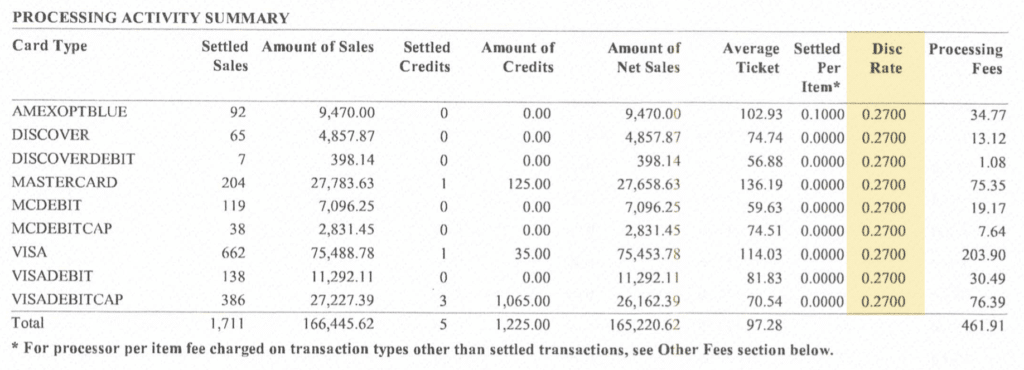
This particular merchant is paying 0.27% (27 basis points).
You can compare this against your original Worldpay merchant agreement. And if it’s more than you agreed to, that’s an argument you can use when we get to the negotiation stage later on.
For some Worldpay accounts, the discount rate column is omitted from statements.
If you fall into that category, then you’ll need to do some quick math to calculate Worldpay’s markup. I have a separate guide on what to do if your rate isn’t on your statement (and I actually used Worldpay as the example, so it will be easy for you to follow for this exercise).
Isolate Worldpay’s Total Markup From Your Effective Rate
Your Worldpay discount rate doesn’t tell the full story. And your effective rate alone doesn’t tell you what Worldpay is charging you elsewhere.
Here’s why:
- Discount rate only covers Worldpay’s percentage markup on each transaction.
- Effective rate includes everything you pay to process cards (Worldpay’s markup, interchange, network assessments, and other fees).
- And a big chunk of your effective rate is non-negotiable and doesn’t go to Worldpay.
- But Worldpay can also charge you additional fees on top of your discount rate.
So to find out what Worldpay is really charging you:
- Take your total fees
- Subtract interchange, assessments, and non-negotiable pass-through fees
- Divide that number by your total volume
That figure is usually a number that’s much higher than your discount rate alone. And it’s more markup going directly into Worldpay’s pocket.
The end result is the same. Whether it seems like you’re getting a good deal on your discount rate is irrelevant if Worldpay is charging you more elsewhere.
You can also find those additional markups directly by auditing your statement line-by-line:
- Transaction Risk Fees
- Next-Day Funding Fees
- Network Access Fees
- SaferPayments Fees
- FraudSight Fees
- Processor Per-Item Fees
These are just a handful of examples of the extra fees we find on Worldpay statements that are purely processor markups.
And none of them are included in the discount rate shown at the top of your statement.
Skip the “Freebies” and VAS Upsells
Don’t give Worldpay an excuse to charge you more than you’re already paying. But they’re definitely going to try.
One thing that’s happening right now industry-wide is that processors are creating additional products and services that they can tack on to your account in the form of value-added services (VAS). Worldpay is no exception.
Specifically, Worldpay reps are out there trying to pitch Genius POS.
If you already have a working POS, there’s no reason to entertain this offer. You need to remember that you’re dealing with sales reps who are really good at doing their job. So of course they’re going to make this sound like an amazing product that can genuinely help your business.
But at the end of the day, it’s just an upsell. Something that’s going to cost you more money on Worldpay’s payment processing.
Another clever trick we’re seeing right now is that rather than pitching a product, they’re auto-enrolling merchant accounts into a “free trial” of FraudSight. The catch is that it’s only free for a short time, and if you don’t cancel by a certain date, you’ll end up paying for this service every month.
A service you never asked for, never agreed to, and probably don’t need.
All these VAS upsells do is increase Worldpay’s total margin that we covered in the previous section.
Push Back on Rate Increases
Worldpay rate increases are inevitable.
While they haven’t historically been as frequent as other processors on the market, one thing we’ve seen since they were acquired by Global Payments is that the rate increase amounts have skyrocketed.
Here’s an example of a Worldpay increase sent to a merchant effective August 2026:
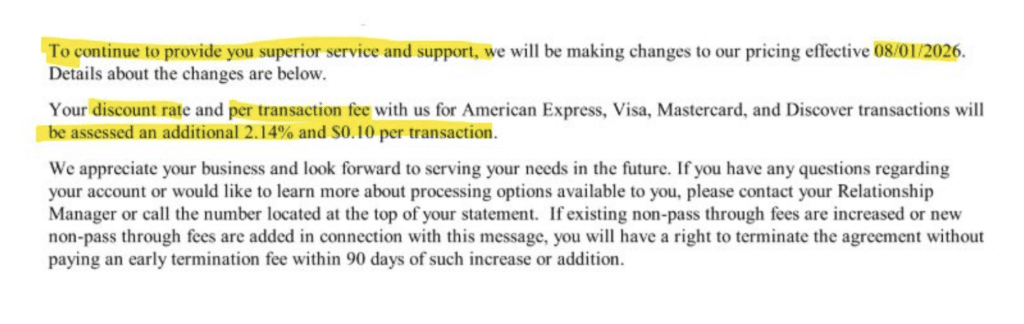
They’re increasing the discount rate on this account by 214 bps. That’s insanely high.
We’ve had clients over the years using Worldpay paying 0.10% + $0.10 per transaction, which is competitive.
And look back to the discount rate screenshot I highlighted earlier in this post. They’re paying a 0.27% markup.
So imagine going from 0.27% to 2.41% overnight just because someone at Worldpay decided to target your account.
What you need to understand about these types of massive increases is that they’re not universally applied. Every merchant in Worldpay’s portfolio didn’t get the same notice, and some of those accounts weren’t touched at all.
This means that the rate is negotiable. Worldpay is hoping you do nothing and just absorb the cost. But if you refuse to accept these terms and reach out appropriately, you can usually get back to your existing rate or accept a slight increase that’s more reasonable and competitive.
Benchmark Your Rate Against Other Worldpay Merchants With Similar Processing Profiles
This part is tricky unless you have a solid network that’s open to discussing their operational costs. You could always post on Reddit and other forums to get a sense of what other people are paying.
But whatever Worldpay happens to be charging other accounts isn’t publicly available.
And if you do find another business using Worldpay that’s willing to share information, the exchange will likely lack context like:
- Volume
- Card mix
- Transaction environment
- Risk profile
There are so many factors to take into consideration here if you’re trying to determine whether your rate is competitive.
That’s when it’s helpful to work with a merchant consultant, which is exactly what we do here at MCC. We have access to hundreds of other Worldpay merchant accounts because those merchants are our clients.
We see the statements every month, and can quickly tell you whether you’re getting a fair price or overpaying based on your specific business profile.
This information becomes invaluable when you’re negotiating with Worldpay because they can’t pretend similar businesses aren’t getting a better rate. You’ll have proof.
Come to the Negotiation Table Prepared to Make a Strong Case
Here’s where everything else you’ve done so far actually comes into play.
You can run all the calculations, identify all the bogus fees, and recognize when you’re paying too much. But none of that matters if you can’t convince Worldpay to lower your pricing.
And there’s definitely a right and wrong way to approach this.
Simply calling or emailing Worldpay and asking for a reduction will likely be stonewalled. They have no incentive to honor this type of request, and their reps are trained to tell you that “there’s nothing they can do” or that you’re “already getting the best rate.”
So you need to show them that you’ve actually done your homework.
- Your discount rate doesn’t match your contract
- They’ve increased your rate however many times in the last three years
- Every non-mandatory pass-through fee has been identified by name, and how much it’s costing you
- What rates are actually competitive for your card mix and business profile
Worldpay doesn’t want to lose your account. And they’re willing to make concessions if you can pull the right strings.
This doesn’t always happen in a single phone call or a few quick email exchanges. But at the end of the day, your position needs to be that you’re not taking no for an answer.
If you need help with this stage or any of the ones mentioned above, we can help. MCC will audit your Worldpay account for free and negotiate with them on your behalf. So you can save money on payment processing while keeping Worldpay as your processor.